
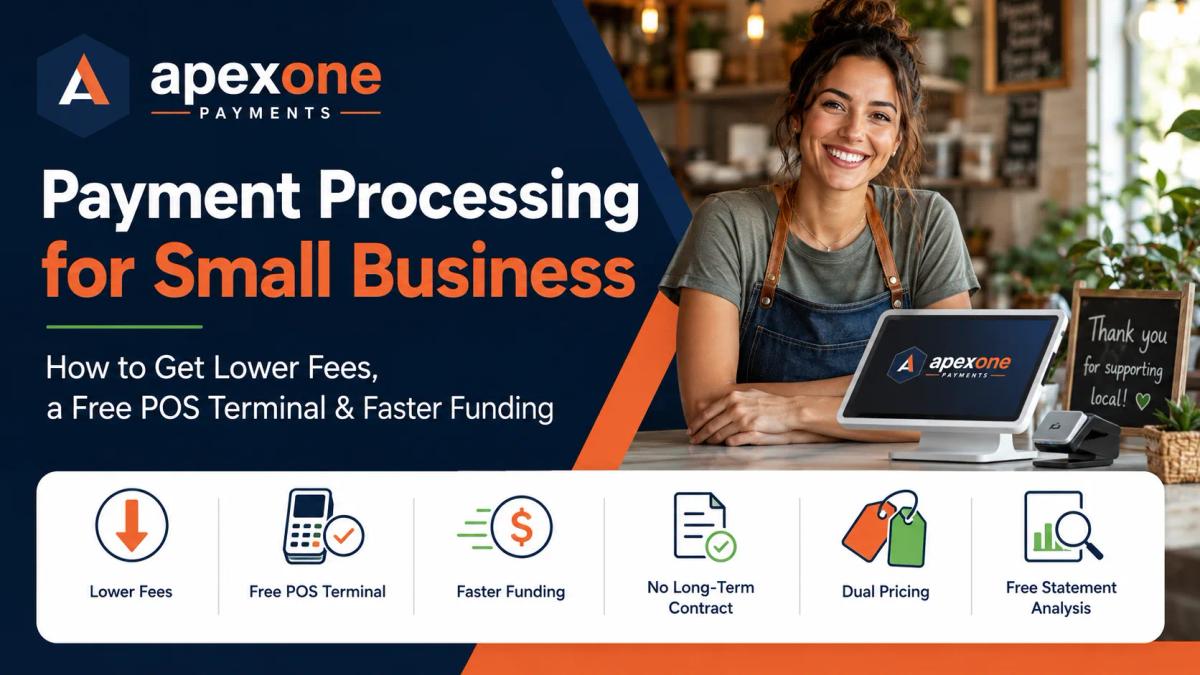
Payment Processing for Small Business How to Get Lower Fees, a Free POS Terminal & Faster Funding
Looking for better payment processing for small business? This guide explains how small businesses can lower processing fees, qualify for a free POS terminal, understand next-day funding, avoid long-term contract surprises, use cash discount or dual pricing programs, and start with a free statement analysis before switching providers.
Most business owners do not switch payment processors because they love payment technology. They switch because something feels wrong.
Maybe the fees are too high. Maybe the deposits take too long. Maybe the terminal is outdated. Maybe the statement is confusing. Maybe the provider promised a “free” machine, but the contract does not feel clear.
That is why choosing the right payment processing for small business is not just about accepting cards. It is about protecting your cash flow, reducing avoidable costs, and making sure your payment setup actually works for the way your business runs.
If you are thinking about switching providers, here are the six things you should ask for before you sign anything.
Why Small Businesses Are Reviewing Their Payment Processor
Running a small business in 2026 is not cheap.
Rent is higher. Payroll is higher. Inventory costs can change quickly. Customers expect fast checkout. Staff members need simple tools. And every time a customer pays by card, your business may be paying processing fees.
That does not mean card payments are bad. Customers want convenience, and businesses need to accept the way people prefer to pay.
The problem starts when payment processing becomes expensive, confusing, slow, or difficult to manage.
A small business payment processor should make things easier, not harder.
The right provider should help you answer simple questions:
- How much am I really paying?
- When will I receive my money?
- Is my POS terminal costing me anything?
- Am I locked into a contract?
- Can I reduce card fee pressure?
- Can someone explain my merchant statement in plain English?
If your current provider cannot answer those questions clearly, it may be time to review your options.
Apex One Payments already has a full guide on payment processing for small business in 2026, but this article is more focused on what to check before switching.
1. Lower Processing Fees: Know What You Are Really Paying
Every business owner wants lower processing fees. That makes sense. Nobody wants to lose more money than necessary on every sale.
But here is the part many owners miss: the lowest advertised rate is not always the lowest real cost.
Some providers show a simple rate upfront, but the monthly statement tells a different story. You may see extra fees for PCI compliance, batch processing, statements, equipment, gateway access, chargebacks, or monthly minimums.
That is why you should not only ask, “What is your rate?”
Ask this instead:
“What is my total effective rate after all fees are included?”
Your effective rate is the real percentage your business pays after all processing charges are counted.
For example, if your business processes $50,000 in card sales and pays $1,750 in total fees, your effective rate is 3.5%.
That number matters more than the rate someone says on a sales call.
What to Check
Before switching, ask the provider:
- What are the transaction rates?
- Are there monthly account fees?
- Are there PCI compliance fees?
- Are there batch fees?
- Are there statement fees?
- Are there gateway fees?
- Are there chargeback fees?
- Are there equipment fees?
- What will my estimated effective rate be?
- Can you explain the full cost using my current statement?
This is where many business owners find hidden credit card processing fees.
Sometimes the problem is not one big charge. It is ten small charges quietly adding up every month.
Apex One Payments has a helpful guide on hidden credit card processing fees that explains what to look for when reviewing your statement.
The goal is not just to lower fees. The goal is to understand your fees.
Because once you understand them, you can make a smarter decision.
2. Free POS Terminal: Helpful Upgrade or Hidden Cost?
A free POS terminal sounds attractive, especially if you are already trying to reduce costs.
And in many cases, it can be a helpful offer.
A retail store may need a modern countertop terminal. A restaurant may need a better checkout device. A salon may need something that supports tips. A service business may need a wireless terminal that can move around.
Getting hardware with no upfront terminal cost can help small businesses upgrade without a large equipment purchase.
But you still need to check the details.
A free POS terminal should not come with confusion.
Some providers may offer a free device, but the cost may be hidden somewhere else. It could show up in higher transaction rates, monthly equipment charges, a long-term contract, replacement fees, or cancellation rules.
That does not mean every free terminal offer is bad. It means you should ask the right questions.
What to Check
Before accepting a free POS terminal, ask:
- Is the terminal truly $0 upfront?
- Do I own the terminal or return it if I cancel?
- Is there a monthly rental or lease fee?
- Are transaction rates higher because the terminal is free?
- What happens if the terminal breaks?
- Is setup support included?
- Does the device fit my business type?
- Are there cancellation fees connected to the equipment?
A free POS terminal should help your business accept payments more easily. It should not become a hidden cost later.
Apex One Payments offers qualified merchants the option to apply for a free Dejavoo QD2 terminal. That page should be the main place readers go if they want to explore the offer and see whether their business qualifies.
3. Next-Day Funding: Why Faster Deposits Can Change Cash Flow
For many small businesses, cash flow is everything.
You may make sales today, but still need to pay vendors, staff, rent, suppliers, inventory, fuel, or bills quickly. Waiting too long for deposits can create stress, especially for restaurants, retail stores, service businesses, salons, food trucks, and repair shops.
That is why next-day funding can be valuable.
Next-day funding means your card sales may be deposited faster than a slower standard funding schedule, depending on the processor, approval, batch timing, bank rules, risk review, and business type.
The important word is availability.
Not every business automatically qualifies for next-day funding, and timing can depend on several factors. A trustworthy provider should explain what is available for your business before you sign.
Why It Matters
Faster funding can help you:
- Cover payroll sooner
- Reorder inventory faster
- Pay suppliers on time
- Improve daily cash flow
- Reduce stress after busy sales days
- Keep business operations moving
Think about a restaurant after a strong weekend. Sales were good, but payroll and vendor payments are coming fast. Faster access to funds can make the week easier.
Or think about a retail store that needs to restock popular items quickly. Waiting too long for deposits can slow that down.
What to Check
Ask your provider:
- Is next-day funding available for my business?
- Are there extra fees for faster funding?
- What time do I need to batch out?
- Do weekends or holidays affect deposits?
- Does my bank affect timing?
- Are there business types that do not qualify?
- Will funding speed change if my risk profile changes?
Do not accept vague answers.
A good payment processor should explain funding in a way that makes sense.
4. No Long-Term Contract: Flexibility Matters Before You Switch
A long-term contract can make business owners nervous.
And honestly, that is understandable.
Small businesses change. Your sales volume may grow. Your location may change. You may add staff. You may open another location. You may need a different POS system for small business operations later.
Being locked into the wrong payment processor can become expensive and frustrating.
That is why contract flexibility matters.
Before you switch, ask whether the provider requires a no long-term contract option or whether there are early termination fees.
A provider may have standard terms, but you should understand them clearly.
What to Check
Ask:
- Is there a long-term contract?
- How long is the agreement?
- Is there an early termination fee?
- Can I cancel if the service does not fit?
- What happens to my equipment if I leave?
- Is there a cancellation notice period?
- Are there any hidden contract costs?
The point is not that every agreement is bad. The point is that you should never feel trapped.
A strong payment relationship should be built on service, transparency, and fit — not fear.
If your current processor makes you feel stuck, read this Apex One Payments article on signs your business may need a merchant statement review.
Sometimes reviewing the statement is the first step toward understanding whether your current provider still makes sense.
5. Cash Discount and Dual Pricing Program: A Smarter Way to Handle Card Costs
Credit card processing fees are one of the most frustrating costs for small business owners.
You make the sale. The customer pays by card. Then part of that sale goes toward processing costs.
For businesses with tight margins, this can hurt.
That is why many owners are looking into a cash discount program or dual pricing program.
The idea is simple: customers see a clear difference between the cash price and the card price.
For example:
- Cash price: $100
- Card price: $103
This gives customers a choice. They can pay the lower cash price, or they can pay by card with the cost of card acceptance included.
A dual pricing program can help businesses manage card processing costs more transparently when it is set up correctly.
Why It Can Help
A cash discount or dual pricing program may help:
- Reduce the impact of credit card processing fees
- Give customers payment choice
- Protect small business margins
- Make card costs more transparent
- Support businesses with frequent card payments
This can be especially useful for restaurants, retail stores, convenience stores, auto repair shops, salons, service businesses, and other businesses where card payments are common.
But it needs to be done carefully.
Pricing display, receipts, signage, staff training, and compliance rules matter. A provider should not just tell you to add a fee at checkout and move on.
What to Check
Before choosing a cash discount or dual pricing program, ask:
- Is this program supported by the POS terminal?
- Are cash and card prices displayed clearly?
- Are receipts set up correctly?
- Is signage included?
- Is staff training included?
- Is the setup compliant with card brand rules and applicable laws?
- Will customers understand it clearly?
Apex One Payments already has a detailed guide on dual pricing in 2026, and the free Dejavoo QD2 page also mentions support for dual pricing and cash discount programs for eligible businesses.
This is one of the strongest ways to connect savings with payment strategy.
6. Free Statement Analysis: The Smartest First Step Before Switching
Before you switch payment processors, do not start with a sales pitch.
Start with your merchant statement.
Your statement shows what you are really paying. It may include transaction fees, monthly fees, PCI fees, equipment fees, chargeback fees, batch fees, and other charges.
The problem is that many statements are hard to read.
That is where free statement analysis can help.
A free statement analysis means someone reviews your current processing statement and explains what you are paying in plain English.
Not confusing terms. Not pressure. Just the real numbers.
What a Statement Analysis Should Show
A good statement review should help you understand:
- Your monthly processing volume
- Your total monthly fees
- Your effective rate
- Any hidden or extra charges
- Equipment-related costs
- PCI or monthly account fees
- Whether your pricing matches your business type
- Whether there may be savings opportunities
This is powerful because it gives you clarity before you switch.
Instead of guessing, you know.
Instead of trusting a sales claim, you compare numbers.
Instead of focusing only on a “low rate,” you look at the full picture.
Apex One Payments also offers a Payment Savings Calculator, which can help business owners start reviewing their current costs before speaking with the team.
A free statement analysis is one of the best conversion points because it is low-pressure. The owner does not have to switch immediately. They simply get clarity first.
That builds trust.
What These 6 Things Look Like by Business Type
Every small business has different payment needs. The same offer may not work the same way for everyone.
Here is how these six points apply across different industries.
Restaurants
Restaurants need fast checkout, tip support, table-side payments, clear daily reports, and reliable funding.
A restaurant owner should ask about:
- Lower processing fees
- Tip-friendly POS features
- Next-day funding availability
- Dual pricing options
- Countertop and handheld devices
- Support during busy hours
Apex One Payments has restaurant-focused solutions for full-service restaurants, which can be useful for owners comparing payment tools.
Retail Stores
Retail stores care about speed, inventory, refunds, deposits, customer experience, and reporting.
A retail owner should ask about:
- Free POS terminal options
- Lower transaction costs
- Inventory-friendly POS tools
- Clear merchant account fees
- Statement analysis
- Faster deposit options
Retail owners can also review the Apex One Payments retail POS and inventory platform and the blog on retail payment processing.
Salons and Spas
Salons and spas need simple checkout, tips, customer records, and flexible payment options.
A salon owner should ask:
- Does the POS support tips?
- Can staff use it easily?
- Are customer payment records clear?
- Are fees transparent?
- Is there a free terminal option?
- Can the provider explain the contract clearly?
Apex has pages for salon and spa payment solutions and personal services POS and payments.
Service Businesses
Service businesses often need invoices, payment links, mobile payments, deposits, and faster collections.
A service business owner should ask:
- Can I send payment links?
- Can I collect deposits?
- Is mobile payment supported?
- Can I access funds faster?
- Are fees clear?
- Is there a long-term contract?
Apex One Payments has a blog on payment processing for service businesses that explains deposits, invoices, and mobile POS in more detail.
Healthcare and Dental Offices
Healthcare offices need clear patient payment options, secure payment workflows, contactless checkout, and strong reporting.
A healthcare office should ask:
- Can patients pay at the front desk?
- Can payment links be sent?
- Are receipts clear?
- Can staff use the system easily?
- Are disputes easier to track?
- Are payment reports simple?
Apex also has a guide on HIPAA-ready patient payments, which is useful for clinics and dental offices reviewing payment options.
The Real Goal: Do Not Just Switch — Switch Smarter
Many small businesses switch processors because someone promised a lower rate or a free terminal.
That can be a good reason to start a conversation, but it should not be the only reason to make a decision.
A smarter switch looks at the full picture:
- Will my processing fees actually be lower?
- Is the free POS terminal clear and useful?
- Is next-day funding available for my business?
- Am I avoiding a long-term contract?
- Can dual pricing or cash discount help reduce fee pressure?
- Will someone review my statement first?
- Does this provider understand my industry?
- Will I get support after setup?
That is the difference between chasing a deal and building a better payment setup.
A deal helps today.
A better setup helps every day.
How Apex One Payments Helps Small Businesses Review Their Options
Apex One Payments works with small businesses that want clearer payment processing, practical POS tools, and support that makes sense.
Depending on the business, that may include:
- Payment processing for small business
- Merchant services for small business
- POS system for small business
- Free POS terminal options for qualified merchants
- Dejavoo QD2 wireless terminal
- Dual pricing and cash discount support
- Payment savings review
- Statement analysis
- Retail payment tools
- Restaurant payment solutions
- Service business payments
- Healthcare payment options
- Reporting and payment technology
Apex One Payments provides merchant services, POS terminal solutions, credit card processing, and business payment technology for restaurants, retail stores, healthcare providers, and service businesses. You can explore the main site at Apex One Payments, review the free Dejavoo QD2 terminal offer, or compare your current costs with the Payment Savings Calculator.
The best part is that a business owner does not have to guess.
You can start by reviewing your current statement and asking the right questions.
Ready to Review Your Current Payment Setup?
Before you switch providers, check the full picture: your processing fees, terminal options, funding speed, contract terms, dual pricing options, and current merchant statement.
Apply for the Free Dejavoo QD2 Terminal, use the Payment Savings Calculator, or contact Apex One Payments to request a payment review.
Final Takeaway: Ask for the Full Picture Before You Switch
Switching payment processors is not just about getting a lower rate.
It is about making sure your payment setup fits your business.
Before you move forward, check these six things:
- Lower processing fees
- Free POS terminal
- Next-day funding availability
- No long-term contract or clear contract terms
- Cash discount or dual pricing program
- Free statement analysis
When these pieces are explained clearly, you can make a confident decision.
And if they are not explained clearly, that tells you something too.
A good payment processor should not rush you. It should help you understand your costs, your options, your equipment, your funding, and your contract before you sign.
Your business works hard for every sale.
Your payment processor should help you keep more of it.
To start, apply for the Apex One Payments free Dejavoo QD2 terminal, use the Payment Savings Calculator, or contact Apex One Payments to request a payment review.
FAQs
1. How can small businesses lower payment processing fees?
Small businesses can lower payment processing fees by reviewing their merchant statement, checking their effective rate, removing unnecessary monthly fees, comparing pricing models, and asking whether dual pricing or a cash discount program is available for their business.
2. Is a free POS terminal really free?
A free POS terminal may have no upfront equipment cost, but business owners should still check transaction rates, account fees, replacement rules, cancellation terms, and whether the device must be returned if they switch providers.
3. What is next-day funding in payment processing?
Next-day funding means eligible card sales may be deposited faster than standard funding timelines. Availability can depend on approval, batch time, bank processing, risk review, and the payment provider’s terms.
4. Why does no long-term contract matter?
No long-term contract or clear contract flexibility matters because small businesses should not feel trapped in a payment setup that no longer fits. Always check cancellation terms, early termination fees, and equipment return rules before switching.
5. What is a cash discount program?
A cash discount program gives customers a lower price when they pay with cash. It helps businesses manage card processing costs while giving customers a clear payment choice.
6. What is a dual pricing program?
A dual pricing program shows customers two prices: one for cash and one for card. The card price reflects the cost of accepting card payments, while the cash price gives customers a lower-cost option.
7. What is free statement analysis?
Free statement analysis is a review of your current merchant processing statement. It helps you understand your effective rate, monthly fees, hidden charges, equipment costs, and possible savings opportunities.
8. Should I switch payment processors just for lower fees?
Not always. Lower fees matter, but you should also check support, funding speed, contract terms, POS hardware, reporting, and whether the provider understands your business type.
9. What should I ask before accepting a free terminal?
Ask whether the terminal has no upfront cost, whether you own it or return it, whether there are monthly equipment fees, what happens if it breaks, and whether transaction rates are affected.
10. Can Apex One Payments help review my current payment setup?
Yes. Apex One Payments helps small businesses review payment processing costs, compare POS options, explore free terminal eligibility, and understand whether better payment solutions may fit their business.