
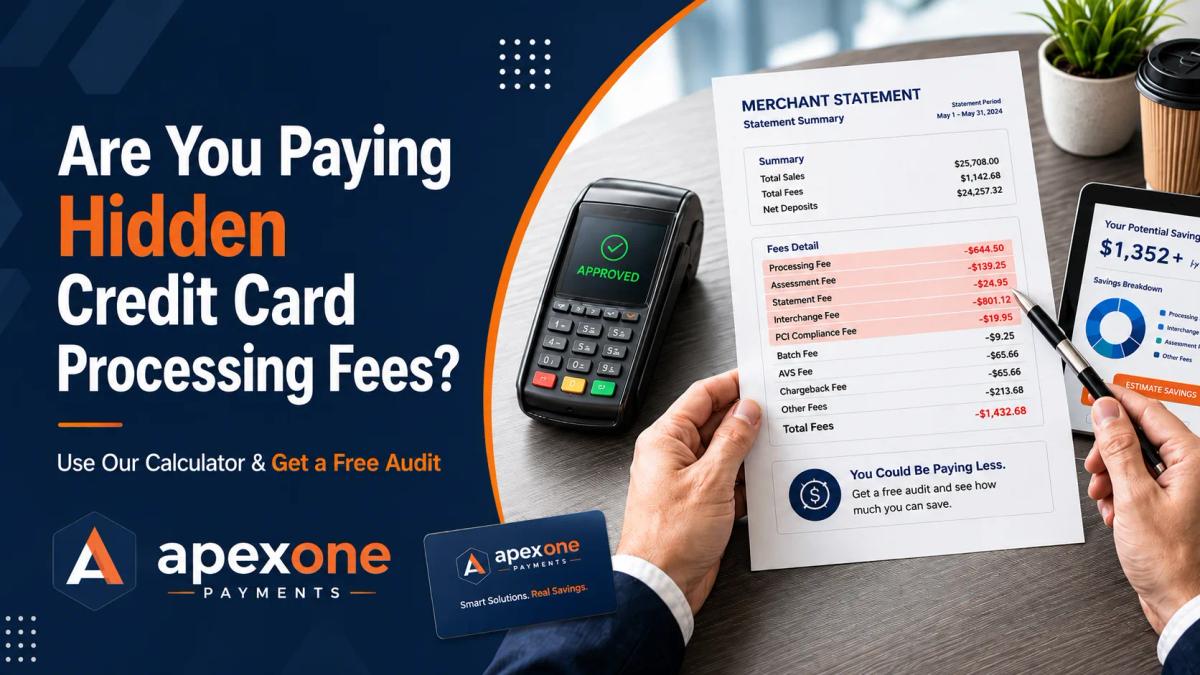
Are You Paying Hidden Credit Card Processing Fees? Use Our Calculator & Get a Free Audit
Wondering if you're overpaying for credit card processing? Learn how to identify hidden merchant fees, understand your processing costs, use our fee calculator, and request a free merchant statement audit from Apex One Payments.
Your Processing Fees May Be Higher Than You Think
Most business owners look at their monthly credit card processing bill and assume the fees are normal. The rate looks small, the statement looks complicated, and the charges often feel like just another cost of doing business.
But here is the problem: many merchants are not just paying a simple processing rate. Their monthly merchant statement may include extra processor markups, statement fees, PCI fees, batch fees, gateway charges, non-qualified transaction rates, and equipment-related costs.
Over time, these small charges can add up fast. Even a slight difference in your effective processing rate can cost your business hundreds or even thousands of dollars per year.
That is why understanding your real payment processing cost matters.
How Payment Processors Add Hidden or Confusing Fees
Not every processor explains pricing in a simple way. Some fees are clearly listed, while others are buried inside long statements or confusing pricing categories. Here are some common charges merchants should review.
1. Monthly Statement Fees
Some processors charge a monthly fee simply for providing your merchant statement. While the amount may seem small, it becomes another recurring cost that increases your total processing expense.
2. PCI Compliance Fees
PCI compliance is important for businesses that accept card payments, but some merchants are charged recurring PCI-related fees without fully understanding what they are paying for. In some cases, merchants may also see additional non-compliance fees if requirements are not completed properly.
3. Batch Fees
A batch fee is usually charged when a merchant closes out daily transactions. These fees are often small, but businesses with frequent daily settlements may see them add up over time.
4. Non-Qualified Transaction Fees
Some transactions are charged at higher rates than others. Rewards cards, business cards, manually entered transactions, keyed-in payments, or certain card types may be downgraded into more expensive pricing categories.
This is one of the biggest reasons a merchant’s actual cost can be higher than the advertised rate.
5. Gateway or Software Fees
If your business accepts online payments, uses a virtual terminal, or connects your POS system with payment software, you may see gateway, platform, or integration fees on your monthly statement.
These tools may be necessary, but the cost should still be transparent.
6. Equipment Lease Fees
Some merchants pay monthly lease fees for terminals or POS equipment for years. In many cases, the total amount paid over time can be much higher than the value of the device itself.
Before signing any equipment agreement, business owners should understand whether they are buying, leasing, renting, or receiving equipment as part of their processing setup.
Why Most Merchants Do Not Notice These Fees
Merchant statements are not always easy to read. They often include multiple pages, card brand categories, authorization fees, assessments, interchange charges, processor markups, monthly fees, and adjustment lines.
For busy business owners, reviewing every line item is difficult.
Restaurants are focused on service. Retail stores are managing inventory. Auto repair shops are handling appointments and invoices. Salons are taking care of clients. Medical and professional service businesses are managing operations, staff, and customers.
Because of this, extra processing fees often go unchecked for months or years.
The issue is not always the rate you were promised. The real issue is what you are actually paying after every fee is included.
What Is a Payment Processing Fee Audit?
A payment processing fee audit is a detailed review of your merchant statement. The goal is to understand your true cost, identify unnecessary charges, and determine whether your current processor is pricing your account fairly.
A proper fee audit can help identify:
- Your real effective processing rate
- Unnecessary monthly fees
- Processor markups
- High-cost transaction categories
- Non-qualified transaction charges
- Gateway or software fees
- Equipment or terminal charges
- Potential savings opportunities
Your effective rate is one of the most important numbers to review. It shows what percentage of your card sales is actually going toward processing costs after all fees are included.
For example, a processor may advertise a low rate, but once extra charges are added, your real cost may be much higher.
Use the Apex One Payments Calculator to Estimate Your Fees
Before switching processors or signing a new agreement, it helps to understand what you are currently paying.
The Apex One Payments calculator gives merchants a simple way to estimate their current processing costs. You can enter your monthly card volume and average processing rate to get a clearer view of how much your business may be spending on merchant fees.
This is a useful first step if you are asking questions like:
- Am I overpaying for credit card processing?
- What is my real monthly processing cost?
- How much could small rate differences cost me each year?
- Should I request a merchant statement audit?
- Is my current processor charging unnecessary fees?
Use the calculator to get an estimate, then compare that estimate with your actual merchant statement.
Use Our Payment CalculatorWhy a Free Statement Audit Can Help
A calculator can help you estimate your costs, but a full statement audit gives you a deeper breakdown.
When Apex One Payments reviews your merchant statement, the goal is to help you understand where your money is going. Instead of guessing, you get a clearer look at the fees, rates, and charges that may be affecting your bottom line.
A free merchant statement audit can help show:
- What your processor is really charging
- Which fees may be unnecessary or inflated
- Whether your effective rate is higher than expected
- Where your business may be losing money
- What payment solution may better fit your business
The best part is that you do not have to decode your statement alone.
Common Signs You May Be Overpaying
You may want to review your merchant statement if:
- Your monthly fees keep changing
- Your effective rate is higher than expected
- You see PCI, statement, batch, or gateway fees you do not understand
- You are paying monthly equipment lease charges
- Your processor promised a low rate but your bill feels high
- You process a high volume of rewards or business cards
- You manually enter many transactions
- You have not compared your processing fees in the last 6 to 12 months
Even if your processor is not doing anything wrong, your current pricing may no longer be the best fit for your business.
Stop Guessing. Know Your Real Processing Cost.
Credit card processing fees directly affect your profit. When hidden or confusing charges go unnoticed, your business may be spending more than necessary every month.
Apex One Payments helps merchants understand their real costs, review their statements, and explore better payment solutions built around transparency and savings.
Get a Free Merchant Statement Audit
Not sure what your processor is really charging? Use the Apex One Payments calculator to estimate your current processing fees. Then send us your merchant statement and our team will provide a free audit with a clear breakdown of your fees.
Check Your Fees TodayStop Guessing. Start Saving.
Find out what your current processor is really charging your business.
Get a Free Merchant Statement Audit
Let Apex One Payments review your processing fees and show you where you may be overpaying.
Know Your Real Processing Cost
Use our fee calculator and request a free audit from our payment experts.
Final Takeaway
Your monthly merchant statement may be costing you more than you realize. Hidden processing fees, confusing pricing structures, and unnecessary monthly charges can reduce your profit without drawing attention.
The first step is simple: calculate your estimated fees, review your statement, and request a free audit.
With Apex One Payments, you can get a clearer view of your payment processing costs and make a smarter decision for your business.