
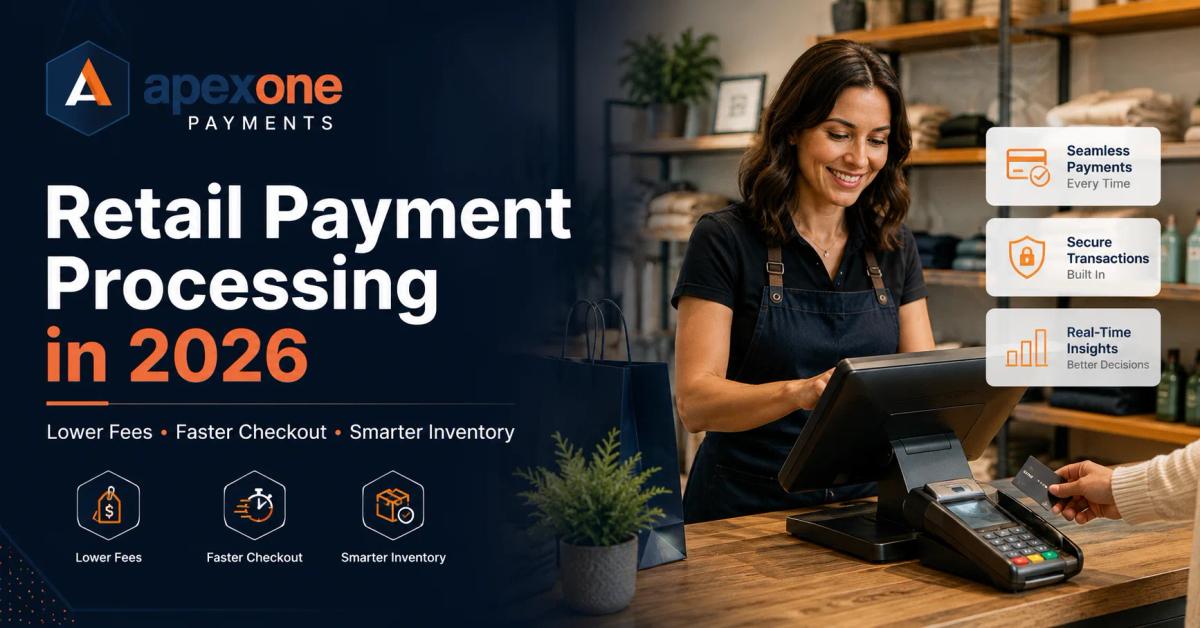
Retail Payment Processing Tips for Store Owners (2026)
Learn how retail payment processing works in 2026, how store owners can lower fees, speed up checkout, manage inventory, and choose the right POS for small businesses.
Running a retail store is not as simple as opening the doors, selling products, and collecting money.
Every day, you are managing customers, inventory, employees, suppliers, returns, discounts, receipts, reports, and payment issues. On top of that, you have to deal with payment processing fees that are not always easy to understand.
A customer taps a card, inserts a chip, or pays through a phone. The sale looks simple. But behind that small transaction, your business may be paying interchange fees, processor markups, monthly fees, statement fees, equipment charges, PCI fees, and sometimes hidden costs you did not even notice.
That is why retail payment processing matters so much in 2026.
For store owners, payment processing is not just about accepting credit cards. It is about building a smoother checkout experience, protecting your profit, managing inventory better, and choosing the right POS for small businesses.
A good payment and POS setup should help you sell faster, understand your numbers, and keep more of your hard-earned money.
In this guide, we will break everything down in simple words. You will learn how retail payment processing works, what fees to watch for, what features matter in a retail POS system, and how Apex One Payments can help small businesses choose a better payment solution.
What Is Retail Payment Processing?
Retail payment processing is the system that allows a retail store to accept customer payments through credit cards, debit cards, mobile wallets, tap-to-pay, online payments, and other digital payment methods.
When a customer pays with a card, the payment moves through a few steps.
The POS terminal sends the payment information to the processor. The processor communicates with the card network and the customer’s bank. The payment is approved or declined. Once approved, the money is later deposited into your business bank account.
This usually happens in seconds, but there are costs attached to almost every card transaction.
That is where many store owners get confused.
They see the sale amount on the receipt, but they do not always see how much they are losing in processing fees until they review the merchant statement.
That is why payment processing for retail stores should be clear, simple, and easy to understand.
Apex One Payments helps businesses accept payments with modern tools, transparent support, and POS solutions built for real business needs. You can learn more about our retail payment and POS solutions.
Why Retail Stores Need More Than a Basic Card Machine
A basic card machine can accept payments. But in 2026, that is not enough for most retail businesses.
Retail store owners need tools that help them run the business, not just collect payments.
A modern POS system for retail can help with:
- Card payments
- Cash payments
- Inventory tracking
- Barcode scanning
- Product management
- Customer profiles
- Returns and exchanges
- Employee access
- Sales reports
- Discounts and promotions
- Gift cards and loyalty
- Online and in-store selling
A card terminal only tells you that a payment happened.
A proper retail POS system tells you what sold, who sold it, when it sold, what payment method was used, and how much inventory is left.
That information is valuable.
For example, if you run a clothing store, convenience store, beauty shop, smoke shop, gift shop, grocery store, jewelry store, or electronics store, you need to know which products are moving and which products are sitting on shelves.
Without that visibility, you can easily overstock slow-moving items and run out of your best sellers.
This is where an all in one POS system becomes very useful. It brings your payments, products, reports, customers, and sales activity into one place.
You can explore Apex One Payments POS and product options to find a setup that fits your business.
Common Payment Processing Problems Retail Store Owners Face
Many retail store owners do not realize how many small payment problems are quietly hurting their business.
Here are some common issues.
High Credit Card Processing Fees
Credit card processing for retail stores can become expensive when the pricing is not clear. Some processors show a low rate upfront but add extra fees later.
These extra charges may include monthly fees, PCI fees, batch fees, statement fees, gateway fees, or terminal fees.
Slow Checkout
Long checkout lines can frustrate customers. If your POS is slow, outdated, or difficult to use, customers may leave or avoid coming back during busy hours.
Fast checkout matters, especially for retail stores with high foot traffic.
Poor Inventory Control
Many stores still use separate systems for payments and inventory. This creates extra manual work and increases the chance of mistakes.
A better best POS system for retail setup should update inventory as sales happen.
No Clear Sales Reporting
If you do not have clear reports, you are guessing.
Good retail reporting helps you understand daily sales, best-selling products, slow days, busy hours, staff performance, and customer buying habits.
Hidden Fees
Hidden payment processing fees are a major problem for small businesses. They can appear in different ways, and many owners do not catch them until months later.
You can read Apex One Payments’ guide on hidden credit card processing fees to better understand what to watch for.
Poor Support
When your payment system goes down, your business can lose sales quickly. Retail store owners need fast, reliable support, not long wait times and confusing answers.
Payment Processing Fees Retailers Should Watch Closely
Retailers should know what they are paying for.
You do not need to become a payment expert, but you should understand the common charges on your merchant statement.
Interchange Fees
These are fees paid to the card-issuing bank. They are part of almost every card transaction.
Processor Markup
This is what your payment processor adds for providing the service. This is one area where costs can vary.
Monthly Fees
Some processors charge monthly service fees just to keep the account active.
PCI Compliance Fees
PCI compliance is related to keeping cardholder data secure. Some providers charge this as a monthly or annual fee.
Statement Fees
Some businesses pay a fee just to receive a monthly statement.
Batch Fees
A batch fee may be charged when you close out the day’s card transactions.
Chargeback Fees
If a customer disputes a charge, your business may be charged a fee.
Equipment Fees
Some businesses pay monthly equipment fees or lease payments for terminals.
Gateway Fees
If you accept online payments, you may also pay gateway fees.
These charges can add up. That is why store owners should review their statements and calculate the real effective rate.
Apex One Payments also offers a payment savings calculator that can help business owners check potential savings.
How the Right POS for Small Businesses Can Help Retail Stores
The right POS for small businesses can make daily work easier.
A good POS system is not just about payment processing. It is about helping you manage the full sale from start to finish.
Here is how it helps.
Faster Checkout
A modern retail POS can speed up transactions, reduce waiting time, and make checkout smoother for customers.
When checkout is fast, customers feel better about the shopping experience.
Better Inventory Management
Every time you sell a product, your inventory should update automatically.
This helps you avoid stock issues and make better buying decisions.
Easier Product Management
A retail POS allows you to organize products by category, price, SKU, barcode, size, color, or department.
This is especially helpful for stores with many items.
Clear Sales Reports
You can see what is selling, when sales are happening, and how your business is performing.
Reports help you make better decisions instead of relying on guesswork.
Employee Tracking
You can set user permissions, track employee sales, and reduce mistakes at the register.
Customer Management
Some POS systems allow you to save customer profiles, purchase history, loyalty points, and contact information.
That helps with repeat business.
Better Payment Flexibility
Customers want options. A strong POS can support tap, swipe, chip, mobile wallet, contactless payments, and sometimes online payments too.
This is why choosing the best POS system for small business operations matters.
Best POS System for Retail: Features Store Owners Should Look For
The best POS system for retail is not always the most expensive one. It is the one that fits your store.
Before choosing a retail POS system, look for these features.
Easy-to-Use Checkout
Your staff should be able to learn the system quickly. If the system is too complicated, mistakes will happen.
Barcode Scanning
Barcode scanning saves time and reduces manual entry errors.
Inventory Tracking
Inventory should update automatically after each sale.
Product Variants
If you sell products in different sizes, colors, flavors, or styles, your POS should handle variants easily.
Returns and Exchanges
Retail stores need a simple return and exchange process.
Discounts and Promotions
You should be able to apply discounts, coupons, and promotional pricing without confusion.
Customer Profiles
Customer history can help with loyalty and repeat sales.
Sales Reporting
Your POS should show daily, weekly, and monthly reports in a clear way.
Multiple Payment Options
A retail POS should support credit cards, debit cards, mobile wallets, cash, gift cards, and contactless payments.
Online Selling Support
Many stores now sell both in person and online. A strong POS should support that growth.
For retail businesses, Apex One Payments provides solutions designed to make payment processing and store management easier. Visit our retail POS and payment solutions page.
POS System for Retail: Why Inventory and Payments Should Work Together
One of the biggest mistakes retail stores make is using separate tools that do not connect.
For example, one system handles payments. Another tracks inventory. Another manages customer information. Another creates reports.
This creates extra work.
When systems do not talk to each other, your team may need to enter the same information multiple times. That increases errors and wastes time.
A better POS system for retail connects payments and inventory together.
So when a customer buys an item, the POS records the sale, accepts the payment, updates the inventory, and adds the transaction to your report.
That is much cleaner.
It helps you know:
- What sold today
- What items are low in stock
- What products are most profitable
- What needs to be reordered
- Which payment methods customers prefer
- Which employee completed the sale
This kind of visibility helps store owners make smarter decisions.
All in One POS System: Is It Better for Retail Stores?
An all in one POS system can be a strong choice for small retail businesses because it combines important tools in one setup.
Instead of using separate tools for payments, inventory, staff, reports, and customer data, everything works together.
This can save time and reduce confusion.
An all in one POS system may include:
- Payment processing
- POS hardware
- Inventory tools
- Sales reporting
- Customer management
- Employee controls
- Receipt options
- Online payment tools
- Gift card support
- Loyalty options
For busy store owners, this matters.
You already have enough to manage. Your POS should not create more work.
An all in one POS system helps you run checkout, track products, and understand sales from one place.
That is why many businesses are moving away from old cash registers and basic terminals.
Merchant Services for Small Business: What Retailers Really Need
Merchant services for small business are the services that allow your store to accept and manage payments.
But retail owners need more than basic card acceptance.
A good retail merchant services provider should offer:
- Clear payment processing
- Fair pricing
- POS hardware options
- Retail POS software
- Fast deposits
- Helpful support
- Chargeback guidance
- Reporting tools
- Online payment options
- Cost-saving programs
The right provider should explain things in simple terms.
You should not need to read a confusing statement for two hours just to understand what you are paying.
Apex One Payments focuses on helping small businesses choose payment solutions that match their industry and daily needs.
That means a retail store gets a setup designed for retail, not a generic one-size-fits-all system.
Free POS Terminal for Retail Stores: What to Check Before You Say Yes
A free POS terminal sounds great. And in many cases, it can be helpful for small businesses that do not want a large upfront equipment cost.
But store owners should always check the details.
Before accepting a free POS terminal, ask these questions:
Is the Terminal Truly Free?
Some offers say “free,” but the cost may be hidden in higher processing fees.
Is There a Contract?
Some free terminal offers come with long-term agreements.
Are There Monthly Fees?
Ask if there are software fees, service fees, equipment fees, or support fees.
What Happens If You Cancel?
You need to know if there are cancellation charges or equipment return rules.
Who Owns the Equipment?
Some providers give equipment. Others lease it.
Are Rates Clear?
Do not only look at the word “free.” Look at the full pricing structure.
A free POS terminal can be a good option when it comes with clear terms, honest pricing, and the right support.
Apex One Payments offers payment and POS options that can help small businesses get the tools they need without unnecessary confusion.
Should Retail Stores Consider Dual Pricing?
Dual pricing is becoming more popular because many small businesses want to reduce card processing costs.
Dual pricing allows a business to show one price for cash and another price for card payments.
This gives customers a choice.
For retail stores, dual pricing can help protect margins, especially when card processing fees keep increasing.
But it needs to be set up correctly.
You need clear signage, proper POS setup, and pricing that follows applicable rules.
When done properly, dual pricing can help business owners reduce the pressure of processing fees while still giving customers payment flexibility.
Apex One Payments has a full guide on dual pricing in payment processing.
Clover POS for Small Business: Is It Right for Retail?
Many retail store owners search for Clover POS for small business because Clover is a popular name in the POS market.
Clover can be a good fit for many businesses because it offers modern devices, touchscreen checkout, apps, reporting, inventory tools, and payment acceptance.
But the device alone is not the full story.
The processor, pricing, contract, and support behind the device matter just as much.
Before choosing Clover or any POS system, ask:
- Does it fit my type of retail store?
- Can it manage my inventory?
- Are the processing fees clear?
- Are there monthly software costs?
- Is support easy to reach?
- Can it grow with my business?
- Are there hidden charges?
- Do I own or lease the equipment?
A good POS should make your business easier to run.
Apex One Payments can help business owners review their needs and choose the right POS and payment processing setup.
Retail Payment Processing for Different Store Types
Different retail stores have different needs. A good payment solution should fit the business.
Convenience Stores
Convenience stores need speed. Customers usually want quick checkout. A retail POS should support fast scanning, quick payments, and easy reporting.
Clothing Stores
Clothing stores often deal with sizes, colors, returns, and seasonal inventory. A POS should handle product variants smoothly.
Smoke Shops
Smoke shops may have many SKUs and fast-moving items. Inventory tracking and quick checkout are very important.
Beauty and Cosmetic Stores
These stores need product tracking, customer history, promotions, and loyalty tools.
Jewelry Stores
Jewelry stores often process higher-ticket purchases. Secure payment processing, detailed receipts, and clear reporting matter.
Gift Shops
Gift shops need flexible product categories, seasonal inventory, and easy discounting.
Electronics Stores
Electronics stores may need inventory tracking, serial numbers, warranties, and higher-value transaction support.
Grocery and Mini-Mart Stores
These stores need barcode scanning, fast checkout, product categories, and reliable payment terminals.
No matter what kind of retail store you run, your payment processing and POS system should match your daily workflow.
How Retailers Can Lower Payment Processing Costs in 2026
Lowering payment processing costs does not always mean switching to the cheapest provider.
It means understanding your current costs and choosing a smarter setup.
Here are practical steps.
Review Your Merchant Statement
Look at the full statement, not just the advertised rate.
Check for monthly fees, PCI fees, batch fees, non-qualified fees, and equipment charges.
Calculate Your Effective Rate
Your effective rate shows what you are actually paying overall.
To calculate it, divide total processing fees by total card sales.
Avoid Unnecessary Equipment Leases
Some businesses pay monthly terminal lease fees for years. That can become expensive.
Choose the Right POS
The right POS can save time, reduce errors, and improve business operations.
Ask About Dual Pricing
Dual pricing may help reduce card fee pressure.
Compare Providers Carefully
Do not only compare rates. Compare service, support, equipment, software, and contract terms.
Use a Payment Savings Calculator
A calculator can help you estimate whether you are overpaying.
You can use Apex One Payments’ payment savings calculator to check your potential savings.
Signs Your Retail Store Needs a Better POS and Payment Processor
Sometimes the problem is obvious. Other times, it slowly builds up.
Here are signs your store may need a better payment setup.
- Checkout takes too long
- Your merchant statement is confusing
- Fees keep increasing
- Inventory is hard to manage
- Your terminal is outdated
- Reports are not clear
- Support is slow
- You cannot accept modern payment methods
- You are paying monthly equipment fees
- Your POS does not match your business needs
- You do not know your true processing rate
If any of these sound familiar, it may be time to review your current setup.
Apex One Payments can help small business owners understand their current payment processing and look for better options. You can contact Apex One Payments to get started.
Why the Cheapest Processor Is Not Always the Best Choice
It is natural to look for the lowest rate.
Every store owner wants to save money.
But the cheapest payment processor on paper may not always be the best choice.
Some processors advertise low rates but add fees later. Others offer cheap processing but poor support. Some provide basic terminals but no real POS tools.
A low rate does not help much if:
- Your system crashes during business hours
- You cannot reach support
- Inventory is always wrong
- Fees are hidden
- Reports are weak
- Customers wait too long
- Equipment is outdated
- You are stuck in a bad contract
The better goal is value.
You want fair pricing, clear terms, reliable hardware, helpful support, and tools that make your business easier to run.
That is what a good retail payment processing partner should provide.
Why Apex One Payments Is a Smart Choice for Retail Businesses
Apex One Payments helps businesses accept payments, manage sales, and choose POS solutions that fit their needs.
For retail store owners, this can include:
- Retail payment processing
- POS for small businesses
- Merchant services for small business
- POS system for retail
- Best POS system for retail guidance
- Credit card processing for retail stores
- All in one POS system options
- Free POS terminal options
- Payment savings support
- Modern POS hardware
- Clearer reporting
- Support for in-person and online payments
Apex One Payments understands that every business is different.
A small clothing store does not need the same setup as a grocery store. A jewelry store does not operate like a smoke shop. A beauty store does not operate like an electronics store.
Your payment system should match your real business needs.
That is the main point.
The right POS and payment setup should help you sell faster, reduce stress, understand your numbers, and protect your profit.
Final Thoughts
Retail payment processing in 2026 is about more than taking card payments.
It is about building a better checkout experience, lowering unnecessary fees, managing inventory smarter, and choosing tools that support your business growth.
A basic terminal may accept a payment, but a strong retail POS system can help you run the store.
If you are serious about improving your retail business, take a closer look at your current payment processing setup. Review your merchant statement. Check your POS features. Look at your inventory process. See if your provider is really helping you or just charging you.
Whether you need payment processing, POS for small businesses, merchant services for small business, best POS system for retail, POS system for retail, free POS terminal, credit card processing for retail stores, or an all in one POS system, Apex One Payments can help you find a better way to accept payments and manage your business.
Start by exploring our retail payment solutions or check your potential savings with the payment savings calculator.
FAQs About Retail Payment Processing
What is retail payment processing?
Retail payment processing is the system that allows retail stores to accept credit cards, debit cards, mobile wallets, tap-to-pay, and other digital payments from customers.
What is the best POS system for retail?
The best POS system for retail should include fast checkout, inventory management, barcode scanning, product categories, returns, employee controls, customer profiles, and clear sales reporting.
Why do retail stores need POS for small businesses?
Retail stores need POS for small businesses because a good POS helps manage payments, inventory, sales reports, customers, employees, discounts, and daily checkout from one system.
What are merchant services for small business?
Merchant services for small business include payment processing, POS systems, card terminals, online payments, virtual terminals, reporting tools, merchant accounts, and other services that help businesses accept payments.
Can a retail store get a free POS terminal?
Yes, some providers offer a free POS terminal, but business owners should check the full terms. Make sure there are no hidden fees, long contracts, high processing rates, or equipment return problems.
How can retail stores lower payment processing fees?
Retail stores can lower fees by reviewing merchant statements, calculating the effective rate, avoiding unnecessary equipment leases, comparing providers, using the right POS system, and considering dual pricing.
Is an all in one POS system good for retail stores?
Yes, an all in one POS system can be a good choice because it combines payment processing, inventory, reporting, customer tools, and employee controls in one setup.
Is Clover POS good for small business retail stores?
Clover POS for small business can be useful for many retail stores, but business owners should review the full setup, including processing fees, software costs, contract terms, support, and inventory features.
What is the difference between payment processing and POS?
Payment processing handles the card transaction. A POS system manages the full sale, including products, payments, inventory, receipts, reports, employees, and customer information.
How do I know if I am overpaying for retail payment processing?
Check your merchant statement and calculate your effective rate by dividing your total fees by your total card sales. Also look for PCI fees, statement fees, batch fees, equipment fees, and other extra charges.