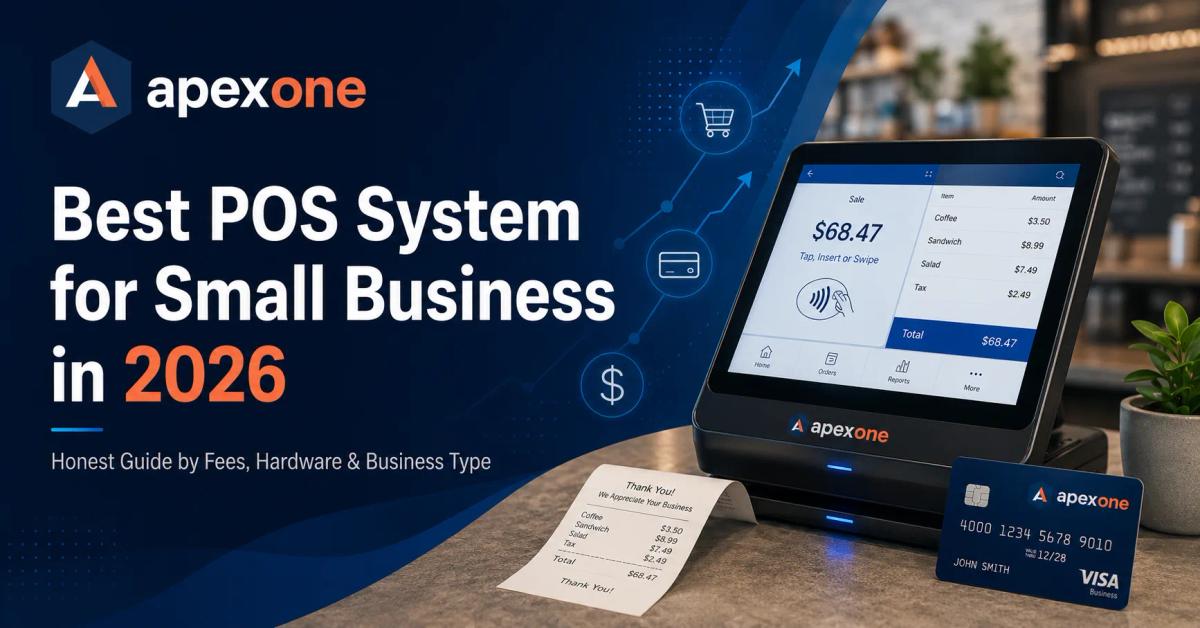
Best POS System for Small Business in 2026 Honest Guide by Fees, Hardware & Business Type
Learn how to choose the best POS system for small business in 2026 by comparing fees, hardware, payment features, dual pricing options, and business type. This honest guide helps small business owners find a payment setup that saves time, reduces confusion, and supports smoother checkout.
Choosing a POS system sounds simple until you actually start comparing options. One company says they are the easiest. Another says they have the best hardware. Another promises low rates. Another gives you a free terminal.
And as a small business owner, you are left asking the real question: Which POS system is actually right for my business?
That is exactly what this guide will help you understand. Because the best POS system for small business is not always the biggest name or the cheapest-looking offer. It is the one that fits your daily workflow, protects your profit, handles your payment volume, and does not leave you confused every time your merchant statement arrives.
The Best POS System Is Not the Same for Every Business
A restaurant does not need the same setup as an auto repair shop. A retail store does not need the same payment flow as a medical office. A food truck does not need the same hardware as a salon, jewelry store, or service business.
So instead of giving you a basic “top 10 POS systems” list, this guide will walk you through what really matters in 2026: fees, hardware, support, payment options, dual pricing, reporting, and business type.
By the end, you will have a much clearer idea of what to look for before choosing your next POS system.
What Is a POS System for Small Business?
A POS system, or point-of-sale system, is the tool your business uses to accept payments and manage checkout.
Years ago, a POS system was mostly a cash register and a receipt printer. Today, it can do much more.
A modern POS system can help you:
- Accept credit and debit card payments
- Take contactless payments and mobile wallet payments
- Print or send digital receipts
- Track sales
- Manage inventory
- Monitor employee activity
- Run reports
- Accept tips
- Send invoices
- Manage customer information
- Support online and in-person payments
In simple words, your POS system is not just where money comes in. It is one of the main tools that keeps your business moving every day.
Why Small Businesses Need a Better POS System in 2026
Running a small business in 2026 is not cheap.
Rent is higher. Payroll is higher. Inventory costs are harder to predict. Customers expect faster service. And every time someone pays by card, your business may be paying credit card processing fees.
That means your POS system should do more than just “take payments.” It should help you run cleaner, faster, and smarter.
A good POS system can help you reduce checkout delays, understand your sales, manage staff better, and keep payment costs under control. A poor POS setup can slow down your team, create confusing reports, limit your payment options, and quietly eat into your profit through unnecessary fees.
If you are still using an old terminal, basic card reader, or a POS system you barely understand, this may be the right time to review your setup.
What Makes the Best POS System for Small Business?
The best POS system is not the one with the longest feature list. It is the one that solves your real business problems.
1. Easy Payment Acceptance
Your POS should make payment simple for both your staff and your customers.
At minimum, it should support credit cards, debit cards, EMV chip cards, tap-to-pay, Apple Pay, Google Pay, contactless payments, printed receipts, and digital receipts.
Customers do not want checkout to feel difficult. They want to pay and move on. Your payment system should make that easy.
2. Clear and Fair Pricing
This is where many small businesses get stuck.
A POS provider may advertise simple pricing, but your real cost may include transaction fees, monthly software fees, statement fees, PCI fees, batch fees, chargeback fees, equipment fees, online payment fees, and keyed-in transaction fees.
That is why you should never choose a POS system based only on the advertised rate. You need to understand your full payment processing cost.
If you are not sure what you are paying now, Apex One Payments offers a helpful Payment Savings Calculator that can help you review your current payment setup and estimate potential savings.
3. Hardware That Fits Your Business
Not every business needs the same device.
A small boutique may need a sleek countertop POS. A food truck may need a wireless terminal. A restaurant may need a station, handheld devices, and kitchen-friendly workflows. An auto repair shop may need invoice payment options and a strong counter terminal. A salon may need tipping, appointments, and customer profiles.
Before choosing hardware, think about how your business actually accepts payments. Do customers come to a counter? Do staff take payments at tables? Do you send invoices? Do you need mobile checkout? Do you sell online and in person?
The answers will help you avoid buying equipment that looks good but does not fit your workflow.
You can also explore available hardware and POS options through the Apex One Payments Shop.
4. Strong Reporting
A good POS system should help you understand what is happening in your business.
You should be able to see daily sales, best-selling items, slow sales periods, staff performance, refunds, tips, payment types, cash vs card sales, and inventory movement.
Without reporting, you are guessing. With reporting, you can make better decisions.
5. Support When Something Goes Wrong
This is one of the most underrated parts of choosing a POS system.
When your terminal stops working during a busy lunch rush or your batch does not settle correctly, you do not want to wait days for help. You need support that understands payments and small business pressure.
A good merchant services partner should help you with setup, hardware, processing questions, statement reviews, pricing concerns, and troubleshooting.
That is where working with a payment partner like Apex One Payments can be helpful. Instead of only giving you equipment, the goal is to help you choose a setup that fits your business and payment needs.
POS System vs Merchant Services: What Is the Difference?
Many business owners use these terms together, but they are not exactly the same.
POS System
Your POS system is the software and hardware you use to accept payments and manage sales. This may include your terminal, register, receipt printer, barcode scanner, customer display, and reporting dashboard.
Merchant Services
Merchant services are the payment processing services that allow your business to accept card payments. This includes processing credit cards, debit cards, online payments, mobile payments, and sometimes additional tools like dual pricing, invoicing, and chargeback support.
Here is the simple way to think about it:
Your POS system handles the checkout experience. Your merchant services handle the movement of money.
Both matter. You can have a nice-looking POS system but still overpay in processing fees. You can also have good processing rates but poor hardware that slows down your staff. The best setup brings both sides together.
Best POS System by Business Type
The best POS system for small business depends heavily on your industry. Let’s break it down in a practical way.
Restaurant POS System
Restaurants need speed, accuracy, and smooth communication between the front of house and back of house.
A restaurant POS system should support table management, menu management, split checks, tip adjustments, kitchen order routing, online ordering, staff permissions, daily sales reporting, and contactless payments.
For full-service restaurants, table flow and tip handling are important. For quick-service restaurants, speed at the counter matters more. For cafés and bakeries, simple checkout and repeat-customer features may be more useful.
If you operate a restaurant, you can also read this Apex One Payments guide: How to Choose the Right POS System for Your Restaurant.
Retail POS System
Retail stores need a POS system that does more than accept payments.
A good retail POS should help with inventory tracking, barcode scanning, product categories, customer profiles, returns and exchanges, sales reports, employee permissions, loyalty programs, and in-store and online sales.
For retail, the best POS system is one that helps you know what is selling, what is not selling, and when to restock.
Apex One Payments also has a helpful article on retail trends here: 5 Payment Trends Retailers Should Watch in 2026.
Auto Repair and Oil Change Shop POS System
Auto repair shops and oil change businesses have a different problem: larger tickets.
A customer may pay $300, $700, or even $1,200 for repairs. When those payments are made by card, processing fees can become expensive quickly.
An auto repair POS setup should help with fast counter checkout, invoice payments, card and contactless payments, digital receipts, customer records, payment links, reporting, and clear processing cost review.
For auto shops, the real issue is not only checkout speed. It is profit protection. Even a small difference in processing fees can matter when your average ticket is high.
Food Truck POS System
Food trucks need mobility. They do not have the same setup as a restaurant with a fixed counter and stable internet.
A food truck POS should support wireless payments, mobile terminals, fast checkout, tap-to-pay, digital receipts, simple menu changes, offline mode, and compact hardware.
For food trucks, every second matters. Long lines can cost sales. The best POS system should help you serve customers quickly without making payment feel complicated.
Salon and Spa POS System
Salons and spas need a POS system that supports both service payments and customer relationships.
Useful features include appointment-friendly checkout, tips, customer profiles, product sales, staff tracking, gift card support, membership payments, package payments, and digital receipts.
For salons, a good POS can help with both payments and repeat business. It should make checkout feel smooth, not awkward.
Healthcare and Clinic POS System
Healthcare businesses have different needs because patient privacy and clean payment communication matter.
A clinic or dental office may need secure patient payments, card-on-file options, digital receipts, payment links, clear reporting, recurring payments, and front-desk-friendly workflows.
If you run a clinic, dental office, or healthcare practice, read this guide from Apex One Payments: HIPAA-Ready Patient Payments: What Clinics Need to Know.
Service Business POS System
Service businesses may not always have a physical checkout counter.
Contractors, repair companies, cleaning businesses, consultants, and mobile service providers often need flexible payment options.
A service business POS setup may include mobile payments, invoices, payment links, recurring billing, digital receipts, online payment acceptance, and customer payment records.
For service businesses, the best POS system is often the one that helps you get paid faster after the job is done.
Clover POS for Small Business
Clover is one of the most recognized POS options for small businesses.
Many business owners like Clover because it offers professional-looking hardware, touchscreen devices, inventory tools, employee management, customer features, and reporting.
A Clover POS for small business can be a good fit for restaurants, retail stores, cafés, salons, service counters, high-volume businesses, and multi-location operators.
But here is something many owners miss: the Clover device itself is only part of the setup. Your merchant services provider also matters.
Two businesses can both use Clover but have very different experiences based on pricing, support, setup, and processing structure.
You can learn more about POS comparisons in this Apex One Payments article: Clover vs Square vs Toast: Why Businesses Choose Apex One Payments.
Square vs Clover vs Toast vs Apex One Payments
Many small business owners compare Square, Clover, and Toast when shopping for a POS system. Each option has strengths.
Square
Square is popular with startups and very small businesses because it is easy to start. It works well for simple payment needs, mobile payments, small retail setups, and basic service businesses.
But as businesses grow, some owners start looking for more flexible pricing, stronger hardware options, or more personalized merchant support.
Clover
Clover is known for business-ready POS hardware and strong small business features. It can work well for restaurants, retail stores, cafés, salons, and service businesses. The key is choosing the right provider and setup.
Toast
Toast is built mainly for restaurants. It can be useful for food service businesses that need restaurant-specific tools like kitchen displays, menu management, table service, and online ordering. However, Toast may not be the best fit for every type of small business.
Apex One Payments
Apex One Payments focuses on POS systems, merchant services, payment processing, dual pricing options, and business payment solutions for restaurants, retail stores, healthcare providers, service businesses, and growing merchants.
The difference is the payment strategy. Apex One Payments is not only about giving you a terminal. It is about helping you understand your payment setup, review your fees, choose the right hardware, and build a system that fits your business.
The Hidden Cost Many Small Businesses Ignore: Credit Card Processing Fees
This is where many business owners lose money without noticing.
You may look at your sales and feel like business is going well. But after processing fees, monthly charges, equipment costs, and other fees, your actual profit may be lower than expected.
Credit card processing fees can be confusing because they are often spread across different lines on a merchant statement.
You may see discount rates, interchange fees, assessment fees, processor markup, monthly fees, batch fees, PCI fees, chargeback fees, and equipment fees.
Most owners are busy running the business. They do not have time to decode every line of a statement. But ignoring these fees can be expensive.
That is why Apex One Payments created a guide on this topic: Are You Paying Hidden Credit Card Processing Fees? Use Our Calculator & Get a Free Audit.
Should Small Businesses Consider Dual Pricing?
Dual pricing is becoming a common conversation among small business owners.
The idea is simple: customers see two prices — one for cash and one for card. The card price reflects the cost of accepting card payments, while the cash price gives customers a lower-cost option.
For example, the cash price may be $100 and the card price may be $103.
This model can help some businesses reduce the impact of card processing fees while staying transparent with customers.
Dual pricing may be useful for restaurants, auto repair shops, retail stores, pharmacies, jewelry stores, salons, convenience stores, and service businesses.
But it must be done properly. Signage, pricing display, receipts, card brand rules, and state rules all matter.
Do not just add a fee at checkout and hope it is fine. A good merchant services partner should help you understand how to set it up correctly.
For more detail, read this guide: Guide on Square and Dual Pricing in 2026 – Pros, Cons & Best Alternatives.
You can also read: What Is Dual Pricing in Payment Processing?
What Is an All-in-One POS System?
An all-in-one POS system combines payment acceptance with business management tools.
Instead of using separate systems for payments, reports, inventory, tips, staff, and customers, an all-in-one POS brings those tools into one place.
A good all-in-one POS system may include payment processing, inventory management, employee tracking, customer profiles, sales reporting, online ordering, invoices, tips, receipts, and device management.
This can be very helpful for small businesses because it reduces the number of tools you need to manage.
When your systems are connected, your day becomes easier. Your reports are cleaner. Your staff has fewer steps. Your checkout feels smoother.
How to Choose the Best POS System for Your Small Business
Before choosing any provider, ask yourself these questions.
What Type of Business Do I Run?
Start with your business type. A restaurant needs table tools. A retail store needs inventory. An auto shop needs invoice-friendly payments. A food truck needs mobile payments. A clinic needs secure patient payment workflows. A salon needs tips and customer profiles.
How Do My Customers Usually Pay?
Do most customers pay by card? Do they use mobile wallets? Do they pay online? Do you send invoices? Do you accept deposits? Do you take recurring payments?
Choose a POS system that matches how money actually comes into your business.
What Is My Average Ticket Size?
This is important. A coffee shop with a $9 average ticket has different needs than an auto repair shop with a $700 average ticket.
Higher-ticket businesses should pay close attention to processing fees because small percentage differences can have a bigger impact.
Do I Need Inventory?
If you sell products, inventory matters. Retail stores, boutiques, smoke shops, pharmacies, jewelry stores, and restaurants all need some level of inventory control.
Do I Need Mobile Payments?
If your business moves, your POS should move too. Food trucks, contractors, delivery businesses, mobile repair services, and event vendors need portable payment options.
Do I Understand My Fees?
If you do not understand your current processing fees, choosing a new POS becomes harder.
Before switching, review your current statement. Look at your monthly volume, average transaction size, total fees, equipment costs, and extra charges.
You can also use the Apex One Payments Payment Savings Calculator to get a better idea of your payment costs.
Do I Have Support?
Good support matters more than many owners realize. When payments stop working, your business can lose sales quickly.
Choose a provider that helps with setup, training, device questions, pricing reviews, and payment issues.
Common Mistakes to Avoid When Choosing a POS System
Mistake 1: Choosing Only by Brand Name
A popular brand is not always the best fit. Choose based on your business needs, pricing, support, and growth plans.
Mistake 2: Ignoring Processing Fees
The hardware may look affordable, but the processing fees may cost more over time. Always look at the full cost.
Mistake 3: Buying Hardware Before Understanding Your Workflow
Do not buy a device just because it looks modern. First, understand how your staff takes payments, where customers pay, and what features you actually need.
Mistake 4: Not Planning for Growth
Your business may be small today, but what happens when you add staff, open another location, sell online, or process higher volume?
Choose a system that can grow with you.
Mistake 5: Not Asking About Support
Support is not exciting until you need it. Ask how setup works, how issues are handled, and who you contact when something goes wrong.
Why Apex One Payments Is a Smart Choice for Growing Small Businesses
Apex One Payments is built for business owners who want more than a basic payment app.
With Apex One Payments, businesses can explore POS terminal solutions, merchant services, credit card processing, Clover POS options, dual pricing support, payment savings reviews, retail payment solutions, restaurant payment solutions, healthcare payment solutions, and service business payment solutions.
The goal is simple: help small businesses accept payments smoothly, understand their costs, and choose a system that fits their real operation.
If you are comparing providers, do not only ask, “Which POS is cheapest?”
Ask this instead: Which POS system will help my business run better and keep more profit?
That is the smarter question.
Final Thoughts: The Best POS System Is the One That Fits Your Business
The best POS system for small business in 2026 is not the same for everyone.
A restaurant needs speed and table tools. A retail store needs inventory and reporting. An auto repair shop needs strong payment processing for large invoices. A food truck needs mobility. A salon needs tips and customer profiles. A clinic needs secure payment workflows.
So do not choose a POS system just because another business uses it.
Choose the one that fits your customers, your staff, your payment volume, your fees, and your growth plans.
And before you make a final decision, review your current payment costs. You may be surprised by how much your current setup is really costing you.
If you want help understanding your payment fees or choosing the right POS system, visit Apex One Payments or try the Payment Savings Calculator.
A better payment setup does not just make checkout easier. It can help your business save money, serve customers better, and grow with more confidence.
FAQs About POS Systems for Small Business
1. What is the best POS system for small business in 2026?
The best POS system depends on your business type, payment volume, hardware needs, inventory needs, and processing fees. A restaurant, retail store, salon, food truck, auto repair shop, and clinic all need different features. The best choice is the one that fits your daily workflow and helps you manage payments without unnecessary costs.
2. What should I look for in a POS system?
Look for easy payment acceptance, transparent pricing, reliable hardware, strong reporting, inventory tools, employee management, customer support, and flexible payment options. You should also review the merchant services behind the POS system because processing fees can affect your profit every month.
3. Is Clover POS good for small business?
Clover POS can be a strong option for many small businesses because it offers professional hardware, reporting, inventory tools, employee features, and a clean checkout experience. However, your overall experience depends on your provider, pricing, setup, and support.
4. Is Square better than Clover?
Square can be good for startups and simple payment needs. Clover may be better for businesses that want more advanced hardware and a more complete POS setup. The better choice depends on your business type, sales volume, and support needs.
5. What is the difference between POS and merchant services?
A POS system is the hardware and software used to accept payments and manage sales. Merchant services are the payment processing services that move card payments from the customer to your business account. A strong setup should include both a good POS system and reliable merchant services.
6. How much does a POS system cost for small business?
The cost can vary depending on hardware, software, processing fees, monthly fees, and support. Some businesses pay upfront for equipment, while others qualify for terminal offers through their payment provider. The most important thing is to review the total cost, not just the device price.
7. Can a POS system help reduce credit card processing fees?
A POS system itself may not automatically reduce fees, but the right merchant services provider can help you review your pricing, understand your statement, and explore options like dual pricing or better processing structures.
8. What is dual pricing in payment processing?
Dual pricing means showing customers two prices: one for cash and one for card payments. This gives customers a clear choice and can help businesses reduce the impact of card processing fees when done properly.
9. Do small businesses need an all-in-one POS system?
Many small businesses benefit from an all-in-one POS system because it brings payments, reporting, inventory, staff tools, receipts, and customer data into one place. This can reduce manual work and make daily operations easier.
10. How do I know if I am overpaying for payment processing?
Review your merchant statement and look at your total monthly fees compared to your total card sales. If you are not sure how to read your statement, use the Apex One Payments Payment Savings Calculator or request a review to better understand your current costs.
11. What POS system is best for restaurants?
Restaurants should look for a POS system with table management, tip adjustment, split checks, menu tools, kitchen communication, online ordering, and fast checkout. The right setup depends on whether you run a full-service restaurant, quick-service restaurant, café, bar, or food truck.
12. What POS system is best for retail stores?
Retail stores should choose a POS system with inventory tracking, barcode scanning, customer profiles, returns, sales reports, loyalty options, and multi-location support if needed.
13. Can Apex One Payments help me choose a POS system?
Yes. Apex One Payments helps businesses review their payment needs, compare POS options, understand processing costs, and choose a solution that fits their business type, payment volume, and growth goals.
14. Should I switch my current POS system?
You should consider switching if your current POS is slow, confusing, expensive, outdated, difficult to support, or not giving you the reports and payment options your business needs. Before switching, review your current fees and daily workflow.
15. What is the first step before choosing a new POS system?
The first step is to understand your current payment setup. Review your processing statement, hardware, monthly fees, average ticket size, and payment volume. Once you understand what you have now, it becomes much easier to choose the right system.