
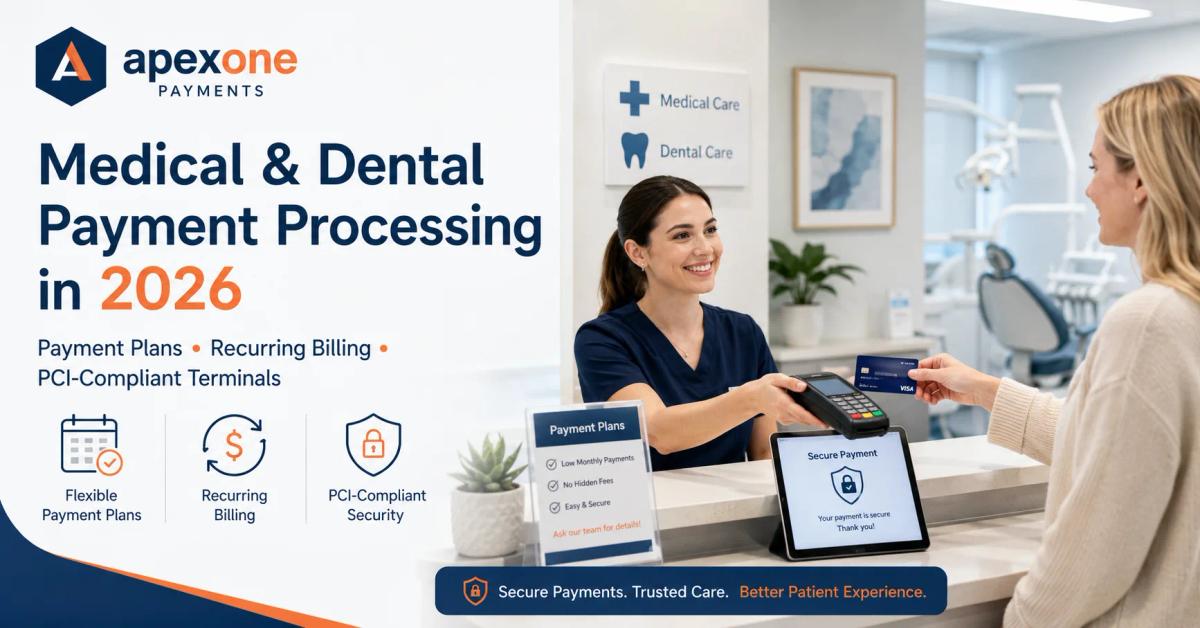
Medical & Dental Payment Processing in 2026 Payment Plans, Recurring Billing & PCI-Compliant Terminals
Medical and dental practices lose time and revenue when patient balances are delayed, treatment deposits are missed, or staff have to chase payments manually. This blog explains how payment plans, recurring billing, card-on-file, pay-by-link statements, and PCI-compliant terminals can help practices collect faster while keeping payments simple and secure for patients.
Medical and dental practices are built around patient care. But even when the care is excellent, payment collection can still create stress for the office.
A patient comes in for a visit. The front desk collects a copay. Insurance is billed. Later, there may be a remaining balance. Someone has to send a statement, follow up with the patient, answer payment questions, take the payment, update the record, and make sure everything reconciles correctly.
For dental offices, the process can be even more complicated. A patient may accept a treatment plan, pay a deposit, come in for multiple visits, use insurance for part of the cost, and pay the remaining balance over time.
That is why medical and dental payment processing needs to be different from regular retail or restaurant payments.
A medical office is not just taking a simple card payment. A dental practice is not just selling a product. These practices deal with patients, privacy, treatment plans, insurance estimates, recurring visits, balances, and front desk workflows.
In 2026, patients expect payment to be simple. They want to pay by card, phone, online link, FSA/HSA card, or through a payment plan. At the same time, practices need secure payment tools, clear reporting, and less manual follow-up.
The right payment setup helps both sides.
Patients get easier ways to pay. Practices collect faster. Front desk teams spend less time chasing balances. Office managers get cleaner reports. Providers keep revenue moving without making payment feel uncomfortable.
That is exactly where Apex One Payments helps medical and dental practices with secure, modern, and patient-friendly payment solutions.
Why Medical and Dental Practices Need Better Payment Tools in 2026
Patient payment responsibility is now a bigger part of healthcare and dental collections.
Many patients have deductibles, copays, coinsurance, dental treatment costs, elective service fees, or recurring care payments. Even when insurance covers part of the service, the patient may still owe money after the visit.
The problem is that many practices still collect payments in an old way.
They wait until checkout. They mail statements. They call patients manually. They re-key card numbers. They track payment plans by hand. They depend on patients remembering to pay later.
That creates delays.
A patient who was ready to pay at the time of care may forget once they leave the office. A dental patient who accepted treatment may delay the deposit. A medical patient may ignore a paper statement. A busy front desk may not have time to follow up quickly.
Better payment tools solve this by making payment easier at the moment the patient is most ready to pay.
Apex One Payments supports secure healthcare payment workflows for clinics and dental offices, including card-on-file, patient statements, appointment payments, FSA/HSA payments, and reconciliation tools. You can explore more here: healthcare payment processing.
The Real Problem: Practices Are Owed Money, But Staff Are Chasing It Manually
Most medical and dental practices do not have a care problem. They have a payment workflow problem.
Patients are more likely to pay when the process is simple. But many payment workflows make it harder than it needs to be.
Here is what often happens.
A patient visits the office. The front desk is busy. The patient has questions. The team collects the copay, but the full estimated amount may not be collected. Insurance processes later. A balance remains. The office sends a statement. The patient misses it or delays it. Staff follow up. More time passes.
That balance is not gone. It is just sitting unpaid.
For dental offices, the same issue happens with treatment plans. A patient accepts treatment, but if the deposit is not collected quickly, the office may lose momentum. The patient may delay scheduling. The treatment may get postponed. The practice loses production and cash flow.
This is why patient balance collection needs to be easier and more proactive.
A strong payment system should help your practice collect copays faster, take treatment deposits, send payment links, offer patient payment plans, store cards securely on file, support recurring billing, accept FSA/HSA payments, reduce manual follow-up, improve reconciliation, and keep the front desk moving.
This is not just about convenience. It directly affects revenue.
What Is Medical and Dental Payment Processing?
Medical and dental payment processing is the system that helps practices accept, manage, and track patient payments securely.
This can include copay collection, credit and debit card payments, FSA and HSA card payments, card-on-file payments, dental treatment plan deposits, patient payment plans, recurring billing, online payment links, pay-by-link statements, chairside dental payments, front desk terminals, telehealth payment links, refunds, disputes, and reconciliation reporting.
The goal is simple: help patients pay in a way that feels easy, while helping your practice collect in a way that feels organized.
A regular card terminal may accept a payment, but medical and dental practices need more than that. They need payment tools that fit healthcare workflows.
For example, a dental office may need to collect a deposit when the patient accepts a treatment plan. A clinic may need to collect a copay at check-in and then charge an authorized card for a remaining balance later. A telehealth provider may need to send a secure payment link before the virtual visit starts.
That is why choosing the right healthcare payment processing setup matters.
Patient Payment Plans Help Patients Say Yes to Care
Patient payment plans can be powerful for medical and dental offices.
Some patients want care but cannot pay the full amount at once. This is common in dental treatment, specialty care, elective services, wellness care, and recurring medical visits.
Without a payment plan, the patient may delay care or avoid treatment completely.
With a simple payment plan, the practice can make care more affordable while still protecting revenue.
A good patient payment plan helps the practice collect a deposit upfront, schedule future payments, reduce unpaid balances, help patients say yes to treatment, improve cash flow, reduce awkward payment conversations, and make care more accessible.
For dental practices, this can be especially important. A patient may need crowns, implants, aligners, periodontal treatment, cosmetic dentistry, or multi-visit restorative care. These services can have higher patient responsibility.
A payment plan gives the patient a path forward.
For medical practices, patient payment plans can help with deductibles, balances, recurring care, specialty treatments, and self-pay services.
The key is to make the process simple. If staff have to manually track every payment plan, the system becomes stressful. A better option is a payment setup that supports scheduled payments, reminders, reporting, and secure card storage.
Apex One Payments supports patient-friendly payment workflows that help clinics and practices manage collections more smoothly. Learn more here: medical clinics and practices.
Recurring Billing Makes Collections More Predictable
Recurring billing is useful when a patient needs to pay over time or returns regularly for care.
Instead of asking the patient to pay manually every month, recurring billing allows the practice to schedule payments based on an agreed plan.
This can help with dental treatment plans, orthodontic payments, membership plans, wellness programs, recurring therapy visits, medical weight loss programs, direct primary care models, ongoing treatment balances, self-pay care plans, and subscription-style services.
Recurring billing helps reduce missed payments because the patient does not have to remember each payment date. It also gives the practice a more predictable collections process.
But recurring billing must be handled carefully.
Patients need clear authorization. Payment details must be stored securely. Staff should not keep raw card numbers written down or saved in unsafe places. The system should support secure card-on-file and clear reporting.
This is where card on file for medical practices becomes important.
Card-on-file allows a patient to authorize a payment method once. The practice can then use tokenized payment information for approved future balances or payment plans. This helps staff avoid re-keying card details again and again. It saves time and reduces risk.
PCI-Compliant Terminals Protect Patients and Practices
Medical and dental practices handle sensitive information every day. Patients already trust the office with personal and health-related details. Payment security should match that same level of care.
A PCI-compliant terminal helps protect card data during payment acceptance.
PCI compliance matters because card payments must be handled securely. Practices should avoid unsafe habits like writing down card numbers, saving card data in spreadsheets, or manually re-entering information without proper protection.
A secure payment terminal should support chip payments, tap-to-pay, contactless payments, mobile wallet payments, secure card entry, tokenized payment storage, clear receipts, front desk checkout, chairside checkout for dental offices, reporting, and reconciliation.
For dental offices, chairside payment can be useful because patients can approve treatment or pay after a procedure without creating extra front desk congestion.
For medical offices, a secure front desk terminal can help capture copays quickly and reduce checkout delays.
The right terminal does more than take payments. It helps create a smoother, safer experience for both staff and patients.
Apex One Payments offers POS and payment products for businesses that need secure and reliable payment acceptance. You can explore options here: POS and payment products.
Card on File Helps Practices Collect Copays and Balances Faster
Many practices lose time because staff have to ask for card information again and again.
Card-on-file can help solve that.
With card-on-file, a patient authorizes the practice to store a tokenized payment method. The practice can then use that payment method for approved copays, balances, recurring plans, or future visits.
This helps practices collect faster because the payment method is already available.
It can be useful for copays, remaining balances, recurring care plans, dental payment plans, missed balance collection, follow-up visits, membership-based care, and telehealth payments.
Card-on-file also helps patients. They do not have to read card numbers over the phone or bring the same card every visit. The process feels easier.
For staff, it reduces re-keying, repeated payment calls, and manual payment handling.
That is the kind of payment workflow modern practices need.
Pay-by-Link Patient Statements Make Payment Easier
Paper statements are easy to ignore.
Patients may forget them. They may lose them. They may plan to call later but never do. The longer a balance sits unpaid, the harder it can become to collect.
Pay-by-link patient statements make payment easier.
Instead of waiting for the patient to mail a check or call the office, your practice can send a branded statement with a secure payment link. The patient clicks the link, reviews the balance, and pays from a phone, tablet, or computer.
This is much easier for the patient and better for collections.
Pay-by-link payments help practices reduce phone-tag collections, make balances easier to pay, speed up patient payments, improve cash flow, lower front desk workload, create a cleaner patient experience, and support mobile-friendly payments.
This is a strong conversion point because it solves a real office problem: patients do not always pay because the process is inconvenient.
Make it simple, and more patients pay.
Dental Treatment Plan Payments Need a Better Workflow
Dental offices have unique payment needs.
A patient may not pay one simple fee after one visit. They may have a treatment plan that includes multiple procedures, insurance estimates, deposits, and patient balances.
This is why dental payment processing needs to support the way dental offices actually work.
Dental practices may need treatment plan deposits, per-procedure billing, chairside checkout, contactless payment terminals, card-on-file, payment plans, recurring billing, recare payment reminders, insurance-related payment records, and clear production and collections reporting.
A patient may say yes to treatment during the consultation. That is the best time to collect a deposit or set up a payment plan. If the office waits too long, momentum can fade.
The right payment tools help the practice turn treatment acceptance into scheduled care and collected revenue.
Learn more here: dental payment processing.
Medical Practice Payments Need More Than a Basic Terminal
Medical clinics also need a payment setup that fits their workflow.
A clinic may collect copays at check-in, process balances after insurance, send statements, accept FSA/HSA cards, collect telehealth payments, and export payment data for reconciliation.
A strong medical payment solution should support copay capture, outstanding balance collection, card-on-file, patient payment plans, pay-by-link statements, telehealth billing, FSA/HSA tender, insurance-ready receipts, daily collections reporting, and reconciliation exports.
These features matter because front desk teams do not have time to chase every balance manually.
The best payment workflow is one that fits naturally into the visit.
Collect what you can before or during the appointment. Make remaining balances easy to pay. Keep patient payment information secure. Give staff one clear view of collections.
That helps the practice collect more without making the patient experience feel cold or aggressive.
FSA and HSA Payments Help Patients Pay With Funds They Already Have
Many medical and dental patients use FSA or HSA cards to cover eligible healthcare expenses.
If your office does not make this easy, patients may delay payment or ask for another statement later.
Supporting FSA and HSA payments can help patients pay faster because they are using funds already set aside for healthcare.
This is useful for medical visits, dental treatments, copays, deductibles, eligible procedures, follow-up balances, specialty care, and wellness services.
For practices, this is not just a payment feature. It is a patient convenience feature.
When patients can pay using the method they already planned to use, collections become smoother.
Better Payment Tools Reduce Front Desk Stress
The front desk is already busy.
They answer phones, greet patients, verify appointments, handle forms, manage check-ins, talk to insurance, collect copays, schedule follow-ups, and support providers.
Payment collection should not add unnecessary stress.
Better payment tools reduce front desk workload by making payment more automatic, organized, and patient-friendly.
Card-on-file reduces repeat card entry. Pay-by-link reduces phone calls. Payment plans reduce awkward balance conversations. Recurring billing reduces missed installments. PCI-compliant terminals reduce card handling risk. FSA/HSA acceptance reduces payment friction. Reconciliation tools reduce end-of-day confusion. Chairside checkout reduces bottlenecks in dental offices.
This is where merchant services for healthcare should support the practice, not slow it down.
If your current processor only gives you a terminal and a confusing statement, it may not be enough for a modern medical or dental office.
Apex One Payments helps practices use payment tools that better match healthcare workflows.
What to Look for in Medical and Dental Merchant Services
Not every payment processor is built for healthcare.
Medical and dental practices should look for payment solutions that support security, flexibility, reporting, and patient experience.
Your payment provider should understand that healthcare payments need privacy-conscious workflows. Apex One Payments has an existing blog on this topic here: HIPAA-ready patient payments.
Your terminals should support secure card payments, chip, tap, contactless payments, and safe checkout.
Card-on-file should help collect copays, balances, and recurring payments without repeatedly entering card details.
Patient payment plans should help patients afford care while helping practices collect more reliably.
Recurring billing should support ongoing balances, dental treatment plans, membership programs, and recurring care.
Pay-by-link statements should let patients pay from any device.
FSA/HSA payment support should make it simple for patients to use eligible healthcare payment cards.
Reconciliation should help the office manager match payments with visits, balances, and reports.
Transparent processing fees also matter. If you are not sure what your current processor is charging, Apex One Payments has a helpful article here: merchant statement review.
You can also use the Apex One Payments calculator to compare your current costs: payment savings calculator.
Is Your Current Payment Setup Costing Your Practice Time and Revenue?
Many practices do not realize their payment system is part of the problem.
They assume unpaid balances are just normal. They assume front desk stress is unavoidable. They assume patients will eventually pay when they receive enough reminders.
But often, the issue is not the patient. It is the process.
Your payment setup may be holding you back if patients often leave with unpaid balances, staff manually follow up on too many payments, dental treatment deposits are not collected quickly, payment plans are tracked manually, patients ask for online payment options you do not offer, you re-key card numbers often, your terminal is outdated, your statements are hard for patients to understand, FSA/HSA payments are difficult to process, you do not have clear reconciliation reports, or you are unsure what you pay in processing fees.
If several of these sound familiar, your practice may need a better payment workflow.
This does not mean you need to completely change your whole practice overnight. It means you should review how payments are currently collected and where the friction is happening.
How Apex One Payments Helps Medical and Dental Practices Collect Smarter
Apex One Payments helps healthcare and dental practices make payment collection easier, safer, and more patient-friendly.
For medical and dental offices, that can include healthcare payment processing, dental payment processing, patient payment plans, recurring billing support, PCI-compliant terminals, card-on-file workflows, pay-by-link patient statements, FSA/HSA payment support, appointment payments, copay collection, chairside checkout, telehealth payment links, payment reporting, reconciliation support, and merchant services for healthcare.
The goal is not just to process payments.
The goal is to help your practice collect faster, reduce front desk stress, and create a payment experience patients can actually use.
Medical and dental practices should not have to chase every balance manually. Patients should not have to struggle to pay. Staff should not have to re-key card details or track payment plans by hand.
Apex One Payments helps practices modernize the payment process without making it feel complicated.
To explore healthcare solutions, visit: healthcare payment processing.
For dental practices, visit: dental payment processing.
For clinics and medical practices, visit: medical clinics and practices.
Ready to Improve Patient Collections?
Your practice does not need to keep losing time on manual payment collection.
If patients are leaving with unpaid balances, if staff are constantly following up, or if your office still depends on outdated payment methods, it may be time to review your setup.
Apex One Payments can help you understand your current payment workflow, review your processing costs, and recommend better tools for your practice.
Start by using the payment savings calculator.
Or speak with Apex One Payments directly here: contact Apex One Payments.
A better payment experience can help your practice collect faster, reduce stress, and give patients a simpler way to pay.
Final Thoughts
Medical and dental practices do not need the same payment setup as a regular retail store.
They need payment tools that fit patient care, insurance balances, treatment plans, copays, deposits, recurring billing, secure card storage, and front desk workflows.
In 2026, the practices that collect better will be the ones that make payment easier for patients and less stressful for staff.
Patient payment plans can make care more affordable. Recurring billing can reduce missed payments. PCI-compliant terminals can support secure checkout. Card-on-file can make future payments easier. Pay-by-link statements can help patients pay from any device. Chairside dental payments can reduce front desk bottlenecks. FSA/HSA payment support can help patients use healthcare funds more easily.
The right system does not just process a card. It supports the way your practice actually runs.
Apex One Payments helps medical and dental practices collect smarter, protect payment workflows, and create a better payment experience for patients and staff.
If your practice is ready to collect patient balances faster, reduce manual follow-up, and modernize payments, Apex One Payments is ready to help.
FAQs About Medical and Dental Payment Processing
What is medical and dental payment processing?
Medical and dental payment processing is the system that helps practices accept and manage patient payments, including copays, balances, treatment deposits, payment plans, recurring billing, card-on-file payments, FSA/HSA payments, and online payment links.
Why do medical practices need patient payment plans?
Patient payment plans help patients pay balances over time instead of delaying care or avoiding payment. They also help practices collect more consistently and reduce manual follow-up.
How does recurring billing help dental offices?
Recurring billing helps dental offices collect scheduled payments for treatment plans, orthodontics, memberships, or multi-visit procedures. It reduces missed payments and makes collections more predictable.
What is a PCI-compliant terminal?
A PCI-compliant terminal is a payment device designed to securely accept card payments while helping protect cardholder data. It can support chip, tap, swipe, contactless payments, and secure checkout workflows.
What is card on file for medical practices?
Card on file allows a patient to authorize a secure, tokenized payment method for future payments, such as copays, balances, or payment plan installments. It reduces re-keying and helps practices collect faster.
What are pay-by-link patient statements?
Pay-by-link patient statements allow practices to send a secure payment link by text or email. Patients can open the link and pay from a phone, tablet, or computer.
Can dental offices collect treatment plan deposits?
Yes. Dental offices can collect treatment plan deposits when patients accept care. This helps secure the appointment, improve case acceptance, and reduce delayed treatment.
Why is FSA/HSA payment support important?
FSA and HSA payment support helps patients use healthcare funds they already set aside. This makes it easier for patients to pay eligible medical or dental expenses.
How can medical and dental practices reduce front desk payment stress?
Practices can reduce front desk payment stress by using card-on-file, pay-by-link statements, payment plans, recurring billing, secure terminals, and better reconciliation tools.
How can Apex One Payments help healthcare practices?
Apex One Payments helps healthcare practices with secure payment acceptance, patient statements, card-on-file, payment plans, appointment payments, FSA/HSA support, dental treatment deposits, chairside checkout, and reporting tools that help collect faster.