
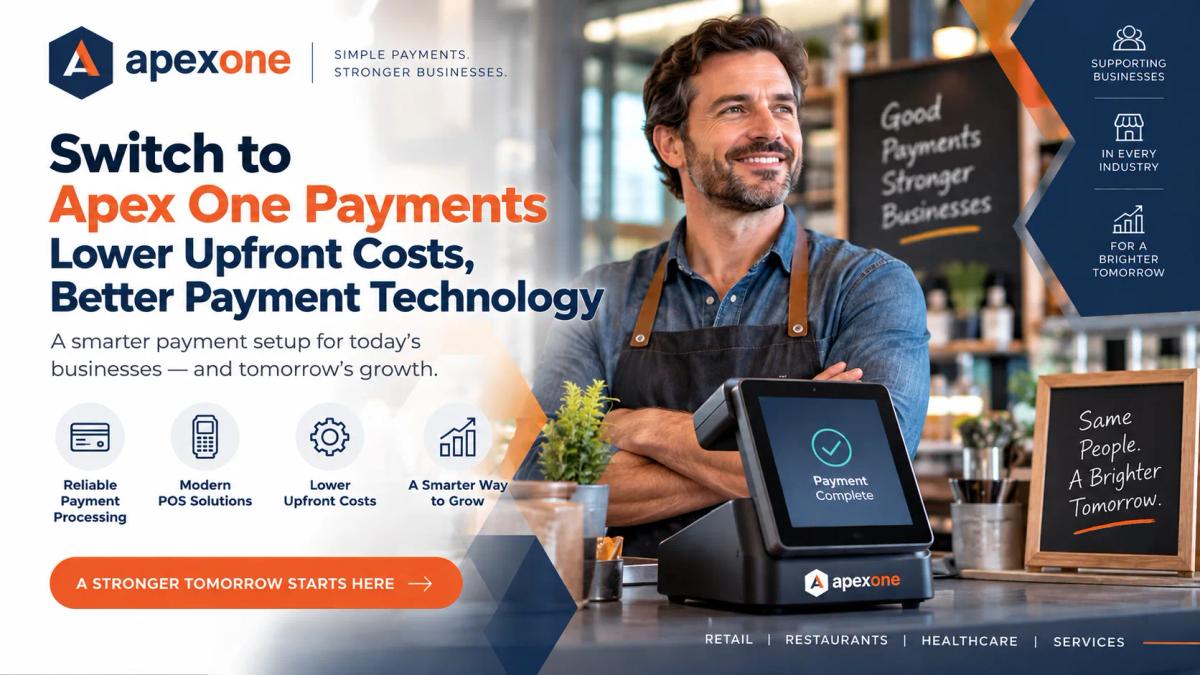
Switch to Apex One Payments Lower Upfront Costs, Better Payment Technology
Your payment provider should make business easier, not more complicated. Discover what businesses can gain by switching to Apex One Payments, from modern POS and payment technology to clearer operations and lower upfront costs.
Choosing a payment provider is one of those decisions that can quietly affect almost every part of a business. It affects how customers pay, how employees complete transactions, how managers review sales, how deposits are tracked, how equipment is supported, and how easily the business can adapt when its needs change. Yet many businesses stay with the same payment provider for years simply because switching feels like a bigger project than it actually needs to be.
The terminal still works. Payments are still being processed. The business is still open. So why change? The better question is what your current payment setup may be costing you in the form of outdated hardware, limited capabilities, disconnected reporting, unnecessary fees, weak support, or technology that no longer matches the way your business operates.
A payment system should keep pace with the business using it. Apex One Payments is built around a broader payment environment that combines payment processing, POS technology, payment hardware, reporting, and industry-specific solutions. For a business that has outgrown its current provider, the decision is not simply about replacing a card machine. It is about moving to a payment setup that makes more sense for the business today and where it is going next.
Your Payment Provider Should Work With Your Business, Not Against It
Most business owners do not choose a payment processor because they enjoy comparing merchant statements. They choose one because they need to get paid. But after the account is opened, the relationship with the payment provider becomes part of everyday operations.
If the equipment is slow, employees notice. If reports are difficult to understand, management notices. If the business needs another payment method and the current setup cannot support it, customers notice. If the company adds another location and the existing technology does not scale properly, everyone notices.
That is when a payment provider stops being a background service and becomes an operational issue. A modern payment relationship should make the business easier to run.
Apex One Payments provides payment processing, POS terminal solutions, credit card processing, and business payment technology for restaurants, retail businesses, healthcare providers, service businesses, and other operators. The objective is not to add technology simply because it is new. The objective is to give the business the right technology for the way it actually operates.
Switching Providers Can Be About More Than Saving on Processing
Price is one reason businesses review their payment provider, but it should not be the only reason. A business can have a low advertised rate and still end up with a payment environment that creates unnecessary work.
The opposite can also be true. A business may discover that the real opportunity is not simply getting a lower rate, but getting better value from the entire payment relationship. That includes the equipment, POS capabilities, reporting, payment options, support, and ability to grow.
Apex's current retail solution, for example, connects checkout, inventory, ecommerce, payments, and reporting across stores and sales channels. Its healthcare platform connects patient payment processing with statements, card-on-file payments, appointment payments, and reconciliation. Its restaurant platform connects ordering, payment processing, tableside service, online ordering, and reporting.
That broader approach matters because payment processing does not happen in isolation. It happens inside the business.
What Makes Switching Worth Considering?
There is no universal reason every business should change payment providers. But there are situations where reviewing the current setup makes good business sense. Maybe the company started with a basic terminal and now needs a complete POS. Maybe the business has expanded and the existing system does not provide enough reporting. Maybe employees are using several disconnected tools. Maybe the hardware is outdated. Maybe customers expect payment options the current setup does not support. Maybe the business owner simply cannot get a clear answer about what is being charged each month.
Or maybe the current provider was a good fit several years ago but no longer fits the business. That last situation is more common than many owners realize. Businesses change, and their payment technology should change with them.
Apex's merchant guidance recommends reviewing the current merchant statement, understanding the effective rate, evaluating equipment and software costs, and comparing the existing setup with the business's actual needs before making a change. That is a much better approach than switching simply because another provider advertises a lower number.
Lower Upfront Costs Can Make a Technology Upgrade Easier
For many businesses, the initial cost of new payment hardware is one of the biggest barriers to upgrading. That is why Apex offers a free Dejavoo QD2 terminal for qualified merchants. The current offer is designed to reduce the upfront hardware cost for businesses that qualify.
Apex's current commercial pages also state that businesses can activate an account with no setup fees and no monthly minimums in the relevant solutions. That changes the conversation. Instead of delaying an upgrade because replacing payment hardware feels like another large expense, a qualified business can explore a lower-upfront-cost path.
But the hardware is only one part of the decision. The real value comes from what the business gets around that hardware.
Better Payment Technology Should Improve the Way You Operate
A payment terminal has one obvious job: accept payments. Modern payment technology can do considerably more.
Apex's retail environment connects payment acceptance with inventory, ecommerce, reporting, customer profiles, loyalty, gift cards, purchasing, returns, and multi-location operations. For restaurants, the platform can support different operating models, including restaurants, quick-service businesses, cafés, food trucks, and other food-service environments. The restaurant platform also includes capabilities such as tableside payments, online ordering, reporting, and location-specific workflows.
For professional service firms, Apex supports invoices, retainers, milestone billing, ACH, card payments, recurring billing, client portals, and mobile approvals.
This is the difference between simply changing a payment processor and upgrading the payment infrastructure behind the business. The goal is not to give you another device. The goal is to give your business a better way to handle payments.
Your POS and Payment Processing Should Work Together
One of the biggest frustrations businesses experience is having a POS system on one side and payment processing on the other. Employees may have to enter information twice, managers may have to compare separate reports, refunds may require additional steps, and payment information may not connect cleanly with the rest of the business.
A better setup keeps the important pieces connected. Apex's retail platform, for example, brings POS, inventory, ecommerce, payments, and reporting into the same operating environment.
That connection becomes increasingly valuable as a business grows. A business with one location may be able to tolerate disconnected systems. A business with multiple locations, more employees, higher transaction volume, and multiple sales channels has much more to gain from connected technology.
Switching Does Not Mean Giving Up the Way Your Business Works
One concern business owners often have is that changing providers means changing everything. That does not have to be the case. The right transition should begin with understanding the business first.
How do customers currently pay? How do employees process transactions? What POS system is being used? How are refunds handled? How are deposits reviewed? Does the business accept payments online? Does it send invoices? Does it operate more than one location? Does it need mobile payments? Does it need reporting by employee, location, product, or service?
These questions matter because the right payment environment depends on the business. Apex provides different solutions across retail, restaurants, healthcare, professional services, and other business types rather than forcing every company into one identical setup.
That gives the conversation a better starting point. Instead of asking, “Which terminal should I buy?” the business can ask, “What payment setup actually fits the way we operate?”
Switching Is Easier When the Business Starts With Its Current Setup
A smart transition starts with what you already have. Before making a move, business owners should understand their existing payment costs, equipment, contracts, reporting, integrations, transaction volume, and operational requirements.
That does not mean staying with the existing provider. It means making the decision based on facts. The transition should be planned around the business rather than rushed because of a sales promotion.
Apex can then evaluate the existing setup and determine which combination of payment processing, POS, hardware, and business tools makes sense.
The Right Upgrade Depends on the Business
There is no single payment setup that is perfect for every company. A retailer may need inventory and omnichannel capabilities, while a restaurant may need tableside payments and online ordering. A healthcare practice may need patient statements, card-on-file payments, appointment deposits, and reconciliation. A professional service firm may need invoices, retainers, ACH, client portals, and mobile approvals. A field-service business may need mobile payment capabilities.
That is why Apex's solutions are organized around different business environments.
For retailers, the Apex retail POS and payment solution connects checkout, inventory, ecommerce, payments, and reporting.
For restaurants, the Apex restaurant POS and payment platform supports payment and operational workflows across different restaurant formats.
For healthcare providers, the Apex healthcare payment solution supports patient payments, statements, card-on-file, appointment payments, and reconciliation.
For professional service firms, the Apex professional services payment platform supports invoicing, retainers, milestones, ACH, recurring billing, and client portals.
Businesses looking for payment hardware can also explore the Apex POS and payment hardware collection.
The point is simple: your payment system should fit your business instead of forcing your business to work around the system.
Better Technology Can Also Improve the Customer Experience
Customers rarely care which payment processor a business uses. They care about whether paying is easy.
They want the checkout process to feel straightforward, the payment method they prefer to be available, and the transaction to move forward without unnecessary delays. They do not want to wait while an employee struggles with an outdated terminal. They want receipts to be clear, refunds to be handled properly, and remote payments to be convenient.
Payment technology therefore becomes part of the customer experience. Apex's restaurant platform supports payment workflows such as tableside transactions and online ordering, while its healthcare platform supports patient-friendly statements and pay-by-link checkout.
These are not simply technical features. They address real moments in the customer relationship.
Better Reporting Gives Owners More Control
Changing payment providers should also be an opportunity to look at reporting. A business should not have to wait until the end of the month to understand what happened.
Modern payment reporting can help management review transactions, sales activity, locations, employees, refunds, and other available information.
Apex's retail solution provides live reporting around sell-through, margin, basket analytics, inventory, and transaction activity. Its healthcare solution also provides reconciliation capabilities that help practices match payments with encounters and exports.
This type of visibility can become increasingly valuable as a business grows. The objective is not to create more reports. It is to make the information a business already generates easier to understand and use.
Why Stay With a Payment Provider That No Longer Fits?
Loyalty to a payment provider can make sense when the relationship is working. But staying simply because switching sounds inconvenient is different.
If your business has changed, your payment requirements may have changed too. Maybe your transaction volume is higher, you added another location, you started selling online, or your customers now expect contactless or mobile payments. Maybe your old POS no longer gives you the reporting you need, your employees are spending too much time working around the system, or you are paying for features you do not use while missing features you actually need.
Those are legitimate reasons to review the relationship. The decision does not have to be emotional. It can be a straightforward business comparison. What are you paying now? What are you getting? What does your business need today? And what should your payment infrastructure look like as the business grows?
Apex One Payments Is Built for Businesses Ready to Move Forward
Apex One Payments is not positioned as a one-size-fits-all payment product. Its current platform spans payment processing, merchant services, POS systems, payment terminals, reporting, and industry-specific solutions.
That matters when switching providers because the decision is rarely just about the processor. It is about the complete payment environment.
A business may need new hardware, a new POS, better reporting, online payments, mobile payment capabilities, or a solution that supports multiple locations. Or it may simply need a payment provider that is easier to work with.
Apex gives businesses the opportunity to review those needs together instead of treating each one as a separate purchase.
Businesses can also review Apex's payment processing for service businesses, POS and payment hardware, and contact page to discuss a solution around their actual operation.
A Better Payment Setup Starts With a Better Conversation
The decision to switch payment providers should not begin with a sales pitch. It should begin with a review.
Look at your current statement, equipment, POS, customer payment methods, employee workflow, and what happens when something goes wrong. Then ask whether your current provider is giving your business the technology and support it needs.
That is where a conversation with Apex One Payments can become useful. You do not have to assume that switching will automatically save money. You do not have to assume that the newest POS is automatically better. You simply need to compare your current payment environment with what your business actually needs.
Switching to Apex Should Be About More Than Getting a New Terminal
A new terminal is useful. But a better payment relationship can be worth much more.
The right provider can give a business better tools for accepting payments, managing transactions, understanding performance, supporting customers, and handling everyday operations.
That is why the decision to switch should be evaluated at the business level. Apex One Payments provides payment processing and payment technology designed for businesses that want more from their payment environment.
Whether the goal is lower upfront hardware costs, better POS capabilities, stronger reporting, more flexible payment options, or a more connected way to operate, the right setup starts with understanding what the business actually needs.
Ready to See What Your Business Could Do With a Better Payment Setup?
If your current payment provider is doing exactly what your business needs, there may be no reason to change. But if your business has outgrown its current setup, if your technology feels outdated, if your payment tools are disconnected, or if you simply want to understand whether there is a better option, it is worth reviewing the numbers and the technology.
Apex One Payments can help you look at the bigger picture.
Start by exploring the Apex payment processing solutions, review the available POS systems and payment hardware, or contact Apex One Payments to discuss what a transition could look like for your business.
The goal is not simply to switch processors. The goal is to move to a payment setup that gives your business more room to operate, serve customers, and grow.
Frequently Asked Questions
Is switching payment processors difficult?
The difficulty depends on the business's current setup, contracts, integrations, payment channels, and data requirements. A well-planned transition can reduce disruption by reviewing the existing environment before the new payment system goes live.
Why should a business consider switching payment providers?
Businesses may review their provider because their fees have become difficult to understand, their equipment is outdated, their POS no longer fits their needs, reporting is limited, support is poor, or their business has grown beyond the original setup.
Can I switch payment processors without changing my entire business operation?
Potentially, yes. The right transition depends on the systems and integrations your business currently uses. The goal should be to identify what needs to change and what can remain in place before making the transition.
Does Apex One Payments offer POS systems and payment hardware?
Yes. Apex provides POS systems, payment terminals, and other payment hardware alongside payment processing and merchant services. Businesses can review the available hardware through the Apex POS and payment hardware page.
Does Apex One Payments offer a free payment terminal?
Apex currently promotes a free Dejavoo QD2 terminal for qualified merchants. Eligibility and offer terms apply, so businesses should confirm their qualification and current terms directly with Apex.
Does Apex One Payments charge setup fees or monthly minimums?
Apex's current retail, restaurant, and healthcare commercial pages state that eligible businesses can activate an account with no setup fees and no monthly minimums. Specific terms can depend on the solution and business, so they should be confirmed before enrollment.
Can Apex One Payments support different types of businesses?
Yes. Apex currently provides dedicated payment and POS solutions for areas including retail, restaurants, healthcare, professional services, and other service businesses.
Can I review my current payment setup before switching?
Yes. Reviewing your current merchant statement, equipment, processing costs, POS requirements, and payment workflow is a sensible starting point. Apex's own merchant guidance recommends understanding the existing setup before making a provider change.
How do I start switching to Apex One Payments?
The best starting point is to discuss your current payment environment, business type, transaction needs, equipment, and POS requirements with Apex. You can contact Apex One Payments to begin that conversation.