
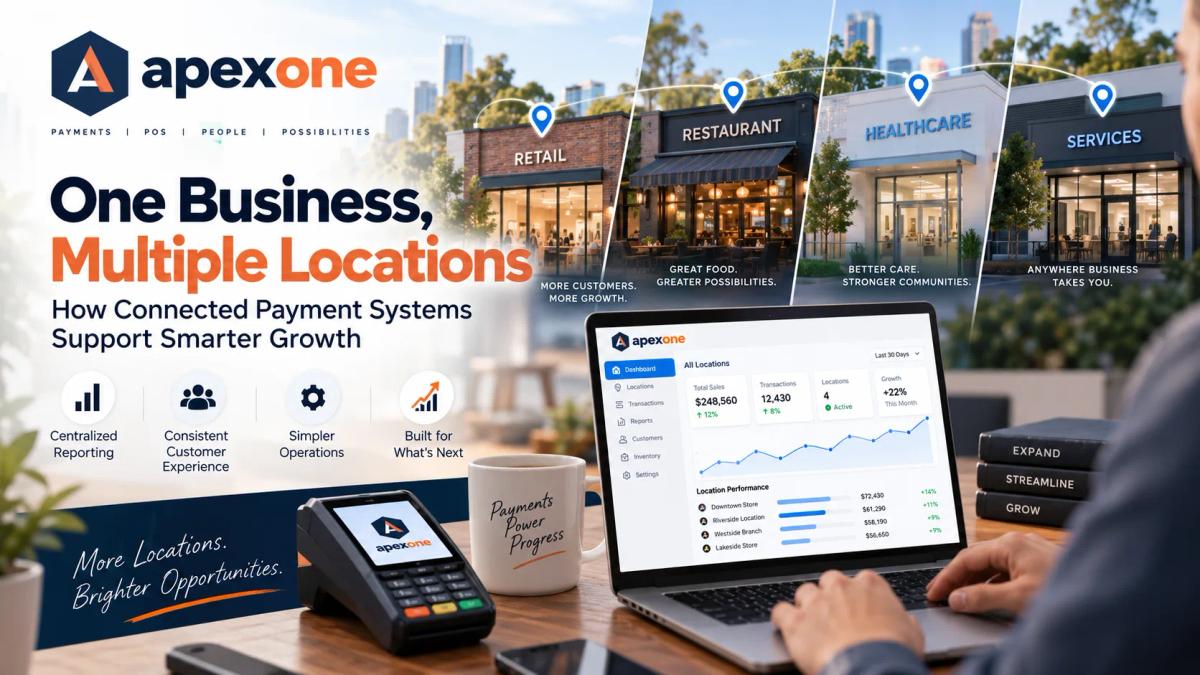
One Business, Multiple Locations How Connected Payment Systems Support Smarter Growth
Opening additional locations should create new opportunities, not a new layer of payment complexity. Learn how connected payment systems can help businesses manage payments, POS operations, reporting, and customer experiences across multiple locations.
Opening a second location is an important milestone for any business. It usually means the first location has created enough demand, revenue, and customer loyalty to justify expansion. But once a business grows beyond one location, the systems behind the business have to grow with it.
Payments are a good example.
At one location, it may be easy to keep track of transactions, deposits, employees, inventory, and daily sales. Once a business has several locations, the same tasks can become much harder when every location operates through disconnected systems. Different terminals, separate reports, inconsistent processes, and scattered payment information can make it difficult for owners and managers to see what is happening across the business.
This is where connected payment systems become valuable.
A modern multi-location payment setup can bring payment processing, POS operations, reporting, and other business functions into a more connected environment. Instead of treating every location as a completely separate operation, businesses can create a more consistent system while still allowing individual locations to operate according to their specific needs.
Apex One Payments already supports this broader approach to business payments. Its retail solutions connect checkout, inventory, ecommerce, payments, and reporting across stores and sales channels, while its restaurant solutions include reporting by location and support for multi-location restaurant groups. Its healthcare solutions also address reporting across multiple locations.
For a growing business, that distinction matters. Expansion should not mean creating more payment complexity every time another location opens. The goal should be to build an infrastructure that gives the business more control as it becomes larger.
Growth Changes More Than Your Store Count
When a business moves from one location to several, the change is not simply physical. The way the business manages money, employees, customers, inventory, and daily operations also changes.
A single-location owner can often remain close to every transaction. They may know which terminal was used, which employee handled a sale, which products are moving quickly, and how the day's revenue looks without needing a complicated reporting system.
With multiple locations, that visibility becomes more difficult.
An owner may be managing several teams at the same time. One location may be having a strong sales day while another is slower. One store may need more inventory while another has excess stock. A restaurant group may have different sales patterns across locations. A healthcare organization may need to review performance across individual offices while maintaining a broader view of the business.
The payment system becomes part of this operational picture.
A business needs to know not only that payments are being processed, but also where transactions are happening, how each location is performing, and whether payment information can be reviewed without manually piecing together data from multiple systems.
This is one reason multi-location payment processing has become an important consideration for businesses planning expansion.
The right system does not eliminate the differences between locations. Instead, it helps the business understand those differences while maintaining a connected view of the organization.
The Problem With Treating Every Location as a Separate Business
Opening additional locations often leads businesses to add technology one location at a time.
A new store gets a new terminal. A new restaurant gets another POS system. A new office starts using another payment account. Reports are stored in different places. Employees receive different instructions. Managers develop their own processes.
At first, this can seem perfectly reasonable.
The problem appears later.
As the number of locations increases, those individual decisions can create a fragmented payment environment. Management may have to compare reports manually. Payment information may be difficult to consolidate. Staff may follow different procedures from one location to another. Hardware may vary between sites. Customer experiences can become inconsistent.
The business may still be processing payments successfully, but the management experience becomes harder.
This is especially important when the business owner is no longer physically present at every location.
A connected payment system gives management a better opportunity to maintain visibility without requiring every location to operate independently.
That does not necessarily mean every location needs to look identical. Local teams may have different schedules, products, services, or customer needs. The important part is having the right underlying structure so the business can see and manage what matters across the organization.
What Makes a Payment System Work for Multiple Locations?
A multi-location payment system should do more than place a payment terminal in every store.
The real value comes from how the different pieces work together.
Payment processing, POS hardware, transaction information, reporting, inventory, and other operational data can become much more useful when they are connected rather than managed separately.
For example, a retailer may want to understand sales across several stores while also keeping track of inventory at each individual location. Apex's retail POS solution is built around this type of connected environment, with inventory tracking across locations and live reporting alongside checkout and payment capabilities.
A restaurant group may need to compare sales between locations while allowing individual restaurants to maintain their own menus or operating requirements. Apex's restaurant platform includes real-time reporting by location and specifically addresses multi-location restaurant groups.
The same principle applies to healthcare and other businesses where management needs a broader view without losing location-level information.
The important question is not simply, "Can this terminal take a card?"
"Can our payment system help us manage the business as we grow?"
That is the difference between purchasing payment hardware and building payment infrastructure.
Centralized Visibility Becomes More Valuable as You Grow
One of the biggest challenges for multi-location businesses is visibility.
When an owner manages one location, checking the day's performance may be relatively straightforward. When there are five, ten, or more locations, the business needs a reliable way to bring information together.
Centralized reporting can help management review activity across locations without treating every report as a completely separate piece of information.
Apex's retail platform, for example, is designed to provide live reporting while tracking inventory and operations across locations. Its healthcare clinic solution also supports consolidated reporting while maintaining information for individual locations.
This type of visibility can change the way management works.
Instead of waiting for every location to send a separate report, leadership can have a clearer view of what is happening across the organization. Instead of relying on assumptions, managers can compare location performance and identify differences that deserve attention.
The benefit is not simply having more data.
The benefit is being able to use that data without creating more administrative work.
Location-Level Data Still Matters
Centralized reporting does not mean businesses should lose visibility into individual locations.
In fact, the opposite is often true.
A multi-location business needs both levels of information.
Management may want to see the entire organization's performance, while a location manager may need to understand what is happening at one particular store, restaurant, or office.
A good payment and POS environment should make it possible to move between these levels of visibility.
Apex's retail platform describes tracking SKUs, variants, and locations in real time across in-store, online, and warehouse operations. Its restaurant platform allows sales to be tracked by location as part of its real-time reporting capabilities.
That type of structure can be especially useful when locations perform differently.
One store may have stronger demand for a particular product. One restaurant may generate more sales during a certain daypart. One office may have a different payment mix from another.
Without location-level information, those differences can be difficult to understand.
With it, management can make decisions based on what is actually happening at each location.
Consistency Matters to Customers Too
Multi-location growth is not only a management challenge. It can also affect the customer experience.
Customers expect a business to feel consistent from one location to another.
They expect payment to be straightforward. They expect employees to understand the process. They expect receipts and transactions to be handled professionally. They should not have to understand how the business's internal systems are structured.
This becomes particularly important for brands that operate several retail stores, restaurants, healthcare locations, or service locations.
A connected payment environment can help businesses create more consistent processes across locations while still giving individual teams the flexibility they need.
For example, a restaurant group can maintain a consistent payment experience while allowing individual locations to operate with location-specific requirements. A retailer can manage products and pricing across stores while maintaining location-level operations.
Customers may never know what payment platform a business uses.
But they notice when the payment experience is slow, confusing, or inconsistent.
Multi-Location POS and Payment Processing Should Work Together
One of the biggest mistakes businesses can make during expansion is treating their POS system and payment processing as completely separate decisions.
The POS is where sales activity is managed. Payment processing is where transactions are completed. When those systems are disconnected, employees may have to enter information manually or managers may need to reconcile information between different systems.
Connected payment environments are designed to reduce that separation.
Apex's current product and industry pages emphasize this connection. Its retail solution brings POS, inventory, ecommerce, payments, and reporting together, while its restaurant platform connects ordering, payment processing, tableside service, online ordering, and reporting.
This becomes more valuable when multiple locations are involved because the number of transactions and operational records increases with the business.
The goal is not to make the technology more complicated.
The goal is to make the business easier to manage.
Expansion Should Not Mean Starting Over With Every Location
A growing business should be able to add locations without rebuilding its entire payment operation every time.
This is where scalability matters.
If the payment infrastructure was designed only for one location, expansion can lead to a collection of separate systems. Each new location creates another set of devices, reports, processes, and management tasks.
A scalable approach looks different.
The business can establish a payment and POS structure that supports additional locations while allowing management to maintain a broader view of operations.
This is particularly important for businesses that know they intend to expand.
A retailer opening its second store may eventually operate ten. A restaurant group may move from two locations to twenty. A service company may expand into several markets. A healthcare organization may add additional offices.
The payment system should not become the reason expansion becomes difficult.
Instead, it should support the business as its footprint increases.
Different Locations Can Have Different Needs
A connected system does not mean every location has to operate in exactly the same way.
This is an important distinction for growing businesses.
A multi-location retailer may have flagship stores, smaller stores, and ecommerce operations. A restaurant group may have full-service restaurants, quick-service locations, cafés, or food trucks. A healthcare organization may have different types of offices with different workflows.
The underlying payment infrastructure can remain connected while individual locations maintain the functionality they actually need.
Apex's restaurant platform demonstrates this approach by supporting different restaurant concepts, including full-service restaurants, quick-service restaurants, cafés, bars, food trucks, and ghost kitchens, while providing connected payment and reporting capabilities.
That flexibility matters because growth rarely produces identical locations.
A business needs a system that can accommodate differences without creating disconnected islands of technology.
Better Payment Management Can Reduce Administrative Friction
Administrative work becomes more expensive as a company grows.
A task that takes ten minutes for one location may become hours of work when repeated across several locations.
Payment reconciliation is one example.
When payment information is spread across multiple systems, management may need to compare reports, deposits, transaction records, refunds, and other information manually.
Apex's reporting and payment products are designed around connected payment information. Its reporting solution emphasizes reliable in-person and online payments and operating the business from one platform, while the Apex Reader page describes transactions flowing into the same ledger as the counter POS, with reporting by day, location, or staff member.
For a multi-location business, that kind of structure can make payment management more practical.
It also gives management more time to focus on the business rather than constantly trying to reconcile information between systems.
A Connected System Gives Owners a Better View of Performance
Business growth creates a new management challenge: distance.
The owner may not be standing behind the counter anymore. They may not be at the restaurant during every shift. They may not be physically present at every office.
That means technology has to provide some of the visibility that physical presence once provided.
Reporting becomes more important.
Management should be able to understand how locations are performing without waiting for information to be manually collected.
This does not mean business owners need endless dashboards or complicated analytics.
It means the important information should be accessible and organized in a way that supports decisions.
Apex's retail and restaurant solutions both emphasize real-time reporting and location-level visibility, while its reporting product is designed to help businesses manage payments and business activity from one platform.
That is the type of infrastructure that becomes increasingly valuable as a company grows beyond one location.
Multi-Location Payment Systems Can Support a More Consistent Brand
When a business expands, the brand experience has to scale with it.
Customers should feel that they are dealing with the same company whether they visit one location or another.
Payment is part of that experience.
A professional payment process, consistent checkout workflow, and reliable POS environment can help maintain that consistency.
For retail businesses, this can extend from physical stores to online channels. Apex's retail platform specifically connects in-store, online, and warehouse operations while supporting unified order management and reporting.
For restaurants, the customer journey can extend from dine-in service to online ordering, pickup, delivery, and tableside payments. Apex's restaurant platform is designed to connect those channels within one restaurant payment and POS environment.
The more channels and locations a business adds, the more important consistency becomes.
A connected payment system helps create a foundation for that consistency.
What Businesses Should Consider Before Expanding Their Payment Infrastructure
The right multi-location payment system depends on the business.
There is no reason for a restaurant group to choose technology based on the needs of a retailer, and there is no reason for a healthcare organization to use the same operational setup as a mobile service company.
The important consideration is whether the payment infrastructure supports the actual way the company operates.
Businesses should consider how many locations they have today, how many they expect to add, how customers pay, how employees process transactions, how management reviews performance, and how information moves between locations.
They should also consider whether their POS, payment processing, hardware, reporting, and other business systems work together or whether employees are constantly moving information between separate tools.
This is where working with a payment provider can be valuable.
Instead of choosing hardware first and figuring out the rest later, businesses can look at the complete payment environment and determine what needs to work together.
Why the Cheapest Payment Setup Is Not Always the Best Choice for Expansion
Cost matters in every business.
But when a company is operating multiple locations, the cheapest individual terminal or processing option is not necessarily the least expensive solution overall.
A lower upfront cost can become less attractive if the system requires more manual work, separate reporting, additional tools, or complicated reconciliation.
The real cost of a payment system includes more than the processing rate or price of a device.
It can also include employee time, management effort, training, operational complexity, hardware replacement, support, and the difficulty of adding new locations.
A business should therefore evaluate payment technology based on the entire operating environment.
The goal should be to find a solution that makes sense financially while also supporting the way the business plans to operate.
That is especially important when the company expects to continue growing.
Why Connected Payment Technology Matters More as Businesses Scale
A single location can sometimes compensate for disconnected systems through human effort.
A manager may keep a spreadsheet. An owner may review several reports manually. Employees may develop workarounds when systems do not communicate.
But those workarounds become harder to maintain as the business expands.
More locations mean more transactions. More employees mean more users. More products mean more inventory records. More sales channels mean more payment information.
At some point, the business has to move from managing complexity manually to building systems that can handle it.
That is where connected payment technology becomes strategically important.
The purpose is not simply to make payment processing more modern.
It is to create an operating environment that can support the business at its current size and continue supporting it as it grows.
How Apex One Payments Supports Growing Multi-Location Businesses
Apex One Payments approaches payment technology as part of the broader business operation rather than treating payment acceptance as an isolated transaction.
Its current website provides solutions across retail, restaurants, healthcare, service businesses, POS hardware, payment processing, and reporting. The retail platform connects checkout, inventory, ecommerce, payments, and reporting across stores and sales channels. The restaurant platform connects ordering, payments, tableside service, online ordering, and reporting, including location-level reporting and support for multi-location groups.
That makes Apex relevant to businesses that are moving beyond a single-location operating model.
For retailers, Apex can connect payment operations with inventory, ecommerce, and reporting across locations. For restaurant groups, the platform supports different restaurant concepts while keeping payment and operational information connected. For healthcare organizations, Apex provides payment and reporting capabilities designed around the needs of practices operating across locations.
Businesses can also explore Apex's POS systems and payment hardware when they are evaluating the technology required at each location.
For companies that need industry-specific solutions, Apex provides dedicated options for retail payment processing and POS, restaurant POS and payment processing, healthcare payment processing, and payment processing for service businesses.
The important point is that businesses do not have to think about every location as an isolated payment operation.
The better question is how the entire payment environment should work as the company grows.
The Right Time to Think About Multi-Location Payments Is Before Expansion Gets Complicated
Businesses often wait until a problem becomes obvious before changing technology.
By that point, employees may already be working around disconnected systems, managers may already be spending too much time on reports, and customers may already be experiencing inconsistent processes.
Expansion is easier when the payment infrastructure is considered before the business becomes difficult to manage.
A company planning its second or third location can think about scalability before adding another terminal. A restaurant group can consider location-level reporting before opening another restaurant. A retailer can think about inventory, ecommerce, and payment connectivity before its store network becomes difficult to manage.
Planning ahead does not mean purchasing technology the business does not need.
It means choosing infrastructure that can support the direction the company is already heading.
Growth Should Add Opportunities, Not Payment Complexity
Opening another location should give a business another opportunity to serve customers and generate revenue.
It should not create another disconnected payment system that management has to monitor separately.
A connected payment environment can help businesses maintain visibility, create more consistent operations, and make payment management easier as the organization expands.
For owners and decision-makers, the objective is straightforward: build a payment infrastructure that supports the business instead of becoming another operational problem.
That means looking beyond the terminal itself.
The payment processor, POS system, hardware, reporting, customer experience, and location management all contribute to how well the payment operation works.
When those pieces are connected, the business has a stronger foundation for growth.
Final Thoughts: Build Payment Infrastructure That Can Grow With Your Business
Growing from one location to several is a significant achievement. But expansion also exposes weaknesses that may not have been obvious when the business was smaller.
Disconnected payment systems, separate reports, inconsistent processes, and limited visibility can become increasingly difficult to manage as more locations are added.
A connected payment system gives businesses a different path.
Instead of managing every location as an isolated operation, businesses can create a payment environment that provides centralized visibility while still supporting the specific needs of individual locations.
That can mean better reporting, more consistent payment experiences, easier management, and a stronger operational foundation for continued growth.
Apex One Payments provides payment processing, POS systems, payment terminals, merchant services, and business payment technology for restaurants, retail stores, healthcare providers, service businesses, and other growing organizations.
If your business is expanding and your current payment infrastructure was built for a single location, now may be the right time to look at what comes next.
Explore Apex One Payments' POS and payment solutions or contact Apex One Payments to discuss a payment setup built around the way your business operates and where you want it to go.
Frequently Asked Questions
What is a multi-location payment system?
A multi-location payment system allows a business to manage payment activity across multiple physical locations through a connected payment environment. Depending on the solution, this can include payment processing, POS systems, reporting, hardware, and location-level management.
Why do growing businesses need connected payment systems?
As businesses add locations, managing separate payment systems can become increasingly difficult. Connected payment systems can provide better visibility, more consistent workflows, and a centralized way to review payment activity across the organization.
Can a multi-location POS system show performance by location?
Yes. Location-level reporting is an important capability for businesses that operate multiple stores, restaurants, offices, or other locations. Apex provides location-level reporting capabilities within its retail and restaurant solutions.
Can different locations have different operating requirements?
Yes. A connected system does not necessarily require every location to operate identically. Businesses may need different products, menus, workflows, or services at individual locations while still maintaining connected payment and reporting infrastructure.
Is a multi-location payment system only useful for large companies?
No. Businesses do not need dozens of locations to benefit from connected payment infrastructure. A company opening its second or third location may already benefit from planning a payment system that can support future expansion.
Can multi-location payment systems connect POS and payment processing?
Many modern payment platforms are designed to connect POS operations and payment processing so businesses can reduce unnecessary manual work and maintain better transaction visibility. The capabilities available depend on the provider and solution.
How can connected payment systems improve reporting?
Connected systems can give management a clearer view of payment activity across locations while still allowing individual locations to be reviewed separately. This can make it easier to compare performance and understand what is happening across the business.
Does Apex One Payments provide solutions for multiple business locations?
Apex One Payments provides payment and POS solutions that support businesses operating across locations. Its retail platform includes location-based inventory and reporting capabilities, while its restaurant platform supports multi-location groups and reporting by location. Apex also provides healthcare and service-business payment solutions.
How do I know if my business needs a multi-location payment solution?
If your business operates or is preparing to operate multiple locations, it is worth evaluating whether your current payment, POS, reporting, and hardware setup can scale with you. If management currently relies on separate systems or manual processes to understand payment activity across locations, a connected solution may be worth considering.
How can I discuss a multi-location payment solution with Apex One Payments?
You can contact Apex One Payments to discuss your business requirements and explore payment processing, POS, hardware, and reporting solutions suited to your operations.