
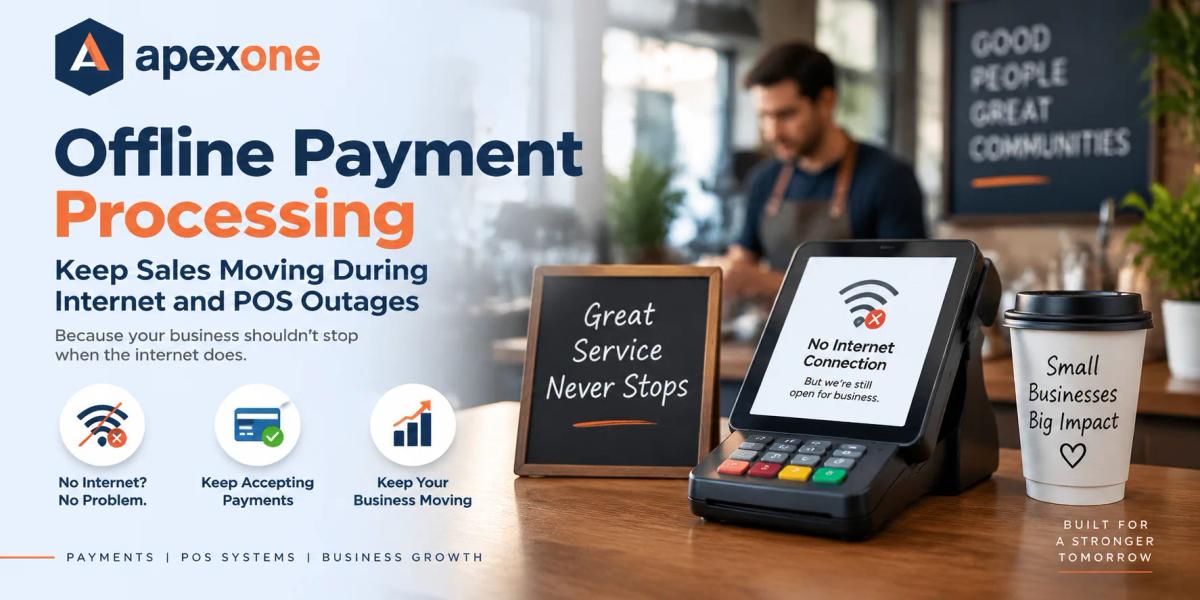
Offline Payment Processing Keep Sales Moving During POS & Internet Outages
A payment outage can interrupt sales at the exact moment customers are ready to buy. Learn how offline payment processing helps businesses handle internet and POS interruptions while maintaining smoother payment operations.
Imagine this situation. Your business is having one of its busiest moments of the day. Customers are ready to complete their purchases, your employees are working quickly, orders are being processed, and everything is moving as expected. Then suddenly, your payment terminal stops working.
The internet connection drops. The POS system cannot communicate properly. Customers are standing at checkout waiting while your team tries restarting devices, checking connections, and figuring out what went wrong.
For customers, the problem feels simple. They are ready to pay, but the payment is not going through. For a business owner, the impact can be much bigger. A payment interruption can slow down operations, create frustration, affect customer experience, and potentially cause lost sales.
This is the reality many businesses face in today's payment environment. Companies across the United States depend on card payments, digital wallets, POS systems, and connected payment technology to complete transactions every day. When those systems experience unexpected interruptions, businesses need a way to continue operating without creating unnecessary disruption.
This is where offline payment processing becomes an important part of a modern payment strategy. Instead of completely stopping transactions during temporary connectivity problems, supported payment systems can continue handling certain transactions and process them once the connection is restored.
For businesses, offline payment processing is not only about technology. It is about maintaining confidence, protecting customer experience, and making sure a temporary outage does not become a complete sales interruption.
Why Payment Downtime Can Become a Business Problem
Electronic payments have become the normal way customers pay for products and services. Whether someone is purchasing items from a retail store, paying for a restaurant order, completing a healthcare payment, or paying for a professional service, customers expect the checkout process to be fast, reliable, and convenient.
Because payment systems are so deeply connected to daily operations, many businesses do not think about payment reliability until something stops working. A terminal that cannot connect, a POS system that loses communication, or an internet outage can suddenly turn a simple payment into a complicated situation.
The challenge is that payment interruptions often happen at the worst possible time. A restaurant may experience a problem during a busy dinner rush. A retail store may face connectivity issues when customer traffic is high. A mobile service business may lose the ability to collect payments while employees are working away from a traditional checkout location.
The cost is not only the transaction that fails. A payment interruption can affect the entire customer journey. A customer who already decided to purchase may become frustrated when the final payment step becomes difficult. Employees may spend valuable time troubleshooting instead of helping customers. Managers may need to stop normal operations to understand what happened.
This is why payment reliability should be viewed as part of customer experience and business operations, not only as a technical issue.
Businesses already invest in better service, faster checkout experiences, and reliable equipment because they understand that small points of friction can influence customer decisions. Payment availability deserves the same level of attention.
What Is Offline Payment Processing?
Offline payment processing is a payment capability that allows supported systems and devices to continue accepting certain transactions when they temporarily cannot connect to the payment processor or payment network.
Under normal conditions, a card transaction moves through a connected payment environment. When a customer taps, inserts, or swipes their card, the payment terminal communicates with the payment processor and relevant networks to request authorization.
During an internet outage or connectivity issue, that communication may not be available. Without a backup process, businesses may be forced to stop accepting payments until the connection returns.
With offline payment capabilities, eligible transactions can be stored securely by supported devices and submitted for processing when connectivity becomes available again. This approach is commonly connected with terms such as offline credit card processing, offline payments, and store-and-forward payments.
The purpose is not to replace normal payment authorization. The purpose is to help businesses maintain operations during temporary interruptions.
A reliable payment setup should give businesses more flexibility when unexpected problems occur while still maintaining proper payment security and transaction controls.
Offline Payment Processing Does Not Mean Every Transaction Is Automatically Approved
One important thing businesses should understand is that offline payment processing does not mean every transaction will automatically succeed.
When a payment is processed normally online, the transaction can communicate with the payment network immediately and receive an authorization decision. During offline processing, that real-time communication may not happen at the same moment.
Depending on the payment system, transaction type, and provider configuration, the payment information may be stored temporarily and submitted once connectivity returns. At that point, the transaction still goes through the normal authorization process.
This means an offline transaction may still be approved or declined after it is submitted.
A professional payment solution should explain both sides of offline processing. The benefit is improved business continuity during temporary interruptions. The responsibility is understanding the limitations and risks involved.
The goal should never be to accept payments without considering security or authorization. The goal should be creating a payment environment that allows businesses to continue operating while managing transactions responsibly.
Why Businesses Should Prepare for POS and Internet Outages
Many businesses assume payment outages are rare enough that preparation is unnecessary. However, modern payment systems depend on multiple connected components working together.
Your POS system, payment terminal, internet connection, payment processor, network provider, and internal employee workflow all influence whether a transaction is completed successfully.
A problem in any one of these areas can interrupt the payment experience.
For example, a restaurant may have an advanced POS system, but if the payment device cannot communicate because the internet connection fails, employees and customers can still experience delays. A retail store may have excellent customer service, but if payment terminals stop responding during a busy period, sales can slow down immediately.
This is why businesses should think about payment continuity before an outage happens.
A strong payment strategy is not only about choosing a processor with competitive pricing. It is also about understanding how your payment environment performs when normal conditions change.
How Offline Payment Processing Helps Different U.S. Businesses
Every business depends on payments differently. A retail store, restaurant, healthcare practice, and service company may all accept card payments, but the way those payments happen and the impact of an interruption can be completely different.
For a restaurant, payment reliability can directly affect the customer experience. A busy dinner service can become stressful when employees cannot quickly process payments after customers finish their meals. Delays at checkout can affect table turnover, employee workflow, and customer satisfaction.
Retail businesses face similar challenges. Customers expect a smooth checkout experience, especially during busy shopping periods. If payment terminals stop working when customer traffic is high, businesses may experience longer lines, frustrated shoppers, and employees spending more time troubleshooting instead of helping customers.
Service businesses can also benefit from reliable payment continuity. Many companies now accept payments away from traditional checkout counters through mobile devices and portable payment terminals. For these businesses, payment flexibility is not just convenient; it is part of how they operate.
Healthcare practices and professional service providers also rely heavily on dependable payment systems. Patients and customers expect convenient payment options, and businesses need a reliable process for collecting payments without unnecessary interruptions.
This is why businesses should not think about offline payment processing as only a technical feature. It is part of creating a payment environment that matches how customers actually interact with the business.
The right payment solution depends on the business model, customer behavior, transaction volume, and operational requirements. A solution that works well for one business may not be the right choice for another.
Apex One Payments helps businesses across the United States evaluate payment solutions based on their actual workflow, including payment processing, POS systems, payment hardware, and transaction management needs. Businesses can explore available payment processing solutions and understand how different payment options can support daily operations.
The Connection Between Offline Payments and Reliable POS Systems
When businesses think about payment reliability, they often focus only on the payment processor. However, the POS system and payment hardware are equally important parts of the payment experience.
A payment terminal is not just a device sitting on the counter. It is the connection point between your customer, your employees, your POS system, and your payment provider. When that connection works smoothly, customers may never think about the technology behind the transaction.
When something goes wrong, however, the impact becomes immediately visible.
This is why choosing the right POS system requires more consideration than simply looking at features or price. Businesses should think about how the equipment performs during real operating conditions, how employees use it every day, how customers interact with it, and what happens when unexpected situations occur.
A restaurant may need mobile payment capabilities for faster service. A retail business may need dependable checkout stations that can handle busy periods. A service company may need portable payment options for accepting payments outside a traditional location.
The best POS solution is the one that supports the way your business actually operates.
Apex One Payments provides different POS and payment hardware options designed for different business environments. Businesses evaluating their current equipment can review available POS systems and payment hardware to understand which solutions better match their operational needs.
For businesses interested in Clover-based payment technology, Apex also provides information about Clover POS devices and payment solutions that can support different business workflows.
What Happens When Your POS System Loses Internet Connection?
A POS internet outage can create confusion because the business may not immediately know where the problem is coming from. The payment terminal may appear normal, but transactions may fail because the device cannot communicate with the payment network.
In these situations, employees often become the first people trying to solve the problem. They may restart devices, check cables, reconnect networks, or attempt transactions again. Without a clear process, small technical problems can quickly become larger operational distractions.
This is why businesses should understand their payment setup before an outage occurs.
Knowing whether your POS system supports offline capabilities, understanding what types of transactions can continue during an interruption, and knowing what steps employees should follow can make a significant difference during a stressful situation.
A prepared business does not wait until customers are standing at checkout to discover how its payment system handles problems.
Instead, it reviews payment continuity as part of normal business planning.
Understanding Store-and-Forward Payments
One term businesses may encounter when researching offline payment processing is store-and-forward payments. This describes a process where eligible transaction information is securely stored when the payment system cannot communicate normally and then forwarded for processing once connectivity is restored.
This approach helps businesses maintain operations during temporary interruptions. Instead of completely stopping transactions because of a short connectivity problem, supported systems can continue handling certain payments and submit them later.
However, businesses should understand that store-and-forward processing does not remove all payment risks. Since the transaction may not receive immediate authorization at the moment of purchase, there can be situations where the transaction is later declined when it reaches the payment network.
This is why businesses should work with payment providers that clearly explain how offline transactions operate, what limitations exist, and how the process fits into their specific business model.
A reliable payment partner should help businesses understand both the opportunity and responsibility that comes with offline capabilities.
How Businesses Can Prepare for Payment Processing Outages
Preparing for payment interruptions does not mean expecting problems every day. It means making sure your business has a plan when unexpected situations happen.
The first step is understanding your current payment environment. Many businesses know which POS system they use and which processor handles their transactions, but they may not know what happens when connectivity is interrupted.
Before an outage occurs, businesses should understand how their payment devices behave during connectivity problems, what transaction types can continue, and what employees should do when normal processing is unavailable.
Employee training is also an important part of payment reliability. Technology can help, but employees still need to understand how to respond when something unusual happens. A team that knows what to do can protect the customer experience better than a team that is forced to figure everything out during a busy moment.
Businesses should also review their reporting and transaction visibility. After an outage or payment interruption, management should be able to understand what happened, which transactions were affected, and whether any follow-up action is needed.
Apex One Payments provides businesses with tools and solutions designed to improve payment visibility. Through payment reporting and analytics, businesses can better understand transaction activity and make more informed decisions about their payment operations.
Why Payment Reliability Matters More Than Ever
Customers today have higher expectations than ever before. They expect businesses to provide fast checkout experiences, convenient payment options, and reliable service regardless of how they choose to pay.
A payment problem may only last a few minutes, but customers often remember the experience. A delayed checkout, a failed transaction, or an employee struggling with equipment can affect how customers view the business.
This is especially important because payment is usually the final interaction between the customer and the business. After the customer has chosen what they want to buy, completed the service, or agreed to move forward, the payment experience becomes the final step before revenue is collected.
A smooth payment process reinforces trust. A difficult payment experience creates unnecessary friction.
This is also why payment reliability connects with other areas of payment performance. A business that wants to improve its payment environment should consider not only outages but also transaction success rates, customer experience, hardware performance, and reporting visibility.
For example, businesses that regularly experience unsuccessful transactions may also benefit from reviewing their payment acceptance rates and card decline patterns.
Offline Payment Processing Is About Protecting Business Continuity
The biggest value of offline payment processing is not that it removes every possible payment problem. No payment technology can guarantee that every transaction will always succeed.
The real value is preparation.
Businesses that understand their payment systems, choose appropriate hardware, train employees, and work with reliable payment providers are better positioned to handle unexpected interruptions without unnecessary disruption.
A payment outage does not have to become a complete business shutdown. With the right payment strategy, businesses can continue serving customers, maintain smoother operations, and reduce the impact of temporary connectivity issues.
How to Choose a Payment Provider That Supports Business Continuity
Choosing a payment provider is not only about finding the lowest processing rate. While pricing is important, businesses should also consider how well their payment partner supports the situations that happen outside of normal operations.
A reliable payment provider should help businesses understand how their payment environment works, what happens during connectivity problems, and what options are available when unexpected issues occur.
Many businesses only evaluate their payment system when they are already experiencing a problem. A terminal stops working, customers cannot complete payments, and suddenly the business starts looking for answers. However, payment reliability should be considered before a problem affects daily operations.
When reviewing a payment solution, businesses should consider whether their provider offers dependable hardware, clear transaction reporting, responsive support, and payment technology that matches the way the business operates.
A restaurant, retail store, healthcare practice, or service business may all have different requirements, but they share one common goal: they need a payment system that helps them serve customers without unnecessary interruptions.
This is why the relationship between a business and its payment provider matters. A payment provider should not only help process transactions. It should help businesses understand their payment environment and make better decisions as their operations grow.
Why Payment Reporting Matters During and After an Outage
When a payment interruption happens, many businesses focus only on getting transactions working again. That is understandable, but understanding what happened afterward is equally important.
Without proper reporting, a business may not know how many transactions were affected, whether specific devices experienced problems, or whether the issue was limited to a certain location or payment channel.
Good payment reporting helps businesses move from guessing to understanding.
For example, if one terminal regularly experiences connectivity issues while others continue working normally, that information can point toward a hardware or configuration problem. If a specific location experiences more payment interruptions than others, management can investigate what makes that environment different.
This type of visibility is valuable because payment problems are not always obvious from the customer side. A customer only sees that a payment failed. The business needs better information to understand why it happened.
Apex One Payments helps businesses gain more visibility into their payment activity through payment reporting and analytics solutions. Better transaction visibility allows businesses to identify patterns, review performance, and make more informed decisions about their payment operations.
How Offline Payment Processing Fits Into a Complete Payment Strategy
Offline payment processing should not be viewed as a replacement for a reliable internet connection, strong payment hardware, or a dependable payment provider. Instead, it should be considered one part of a complete payment strategy.
A strong payment environment combines several important elements working together. Reliable payment hardware helps employees complete transactions smoothly. A capable POS system supports daily operations. Good reporting provides visibility into transaction activity. A knowledgeable payment partner helps businesses understand problems and find solutions.
When these elements work together, businesses are better prepared for unexpected situations.
The goal is not simply to have a backup option when something goes wrong. The goal is to build a payment system that supports the business every day and provides additional flexibility when challenges appear.
Businesses that rely heavily on card payments should think about payment continuity in the same way they think about other important parts of their operations. Just as businesses prepare for equipment issues, staffing challenges, or supply problems, they should also prepare for payment interruptions.
Common Mistakes Businesses Make With Payment Outages
One common mistake businesses make is assuming that every payment problem is caused by the payment processor. In reality, payment interruptions can come from many different areas, including internet connectivity, hardware problems, device configuration, network issues, or employee workflow.
Another mistake is waiting until a major outage happens before understanding how their payment system responds. Businesses often discover their limitations only when customers are already waiting and employees are under pressure.
Some businesses also focus heavily on payment costs while ignoring reliability. Saving a small amount on processing fees may not provide much value if payment problems regularly interrupt sales or create customer frustration.
A complete payment evaluation should consider both cost and performance. A payment system should not only be affordable. It should also support the way your business operates every day.
Keep Your Business Ready When Customers Are Ready to Pay
The final step of a customer transaction is one of the most important moments in the entire buying journey. Your customer has already decided what they want, accepted your product or service, and reached the point where revenue should be collected.
A payment interruption at that moment creates unnecessary friction.
While no business can control every possible technical problem, it can control how prepared it is when those problems happen. The right payment technology, reliable hardware, proper employee awareness, and a trusted payment partner can help reduce disruption and create a smoother experience for both customers and employees.
Offline payment processing is not about pretending outages never happen. It is about making sure a temporary problem does not unnecessarily stop your business from moving forward.
How Apex One Payments Helps Businesses Build More Reliable Payment Operations
Your payment system should do more than simply accept cards. It should support the way your business operates, help your team serve customers efficiently, and provide confidence when unexpected situations occur.
Apex One Payments works with businesses across the United States to provide payment processing solutions, merchant services, POS systems, payment hardware, and technology designed around real business needs.
Whether you are reviewing your current payment setup, upgrading outdated equipment, improving transaction visibility, or looking for payment technology that better matches your workflow, the right solution starts with understanding how your business actually accepts payments.
Businesses can explore Apex One Payments' payment processing solutions to learn how modern payment technology can support daily transactions. Companies looking for updated equipment can review available POS systems and payment hardware designed for different business environments.
For businesses interested in improving their understanding of transaction activity, Apex also provides reporting and analytics tools that help merchants gain better visibility into their payment operations.
The right payment system is not only about what happens when everything works perfectly. It is also about how well your business is prepared when something unexpected happens.
If you are unsure whether your current payment setup is ready for internet interruptions, POS issues, or changing customer expectations, it may be time to review your options.
Contact Apex One Payments to discuss your current payment workflow, technology needs, and how your business can create a more reliable payment experience.
Final Takeaway
Payment interruptions are a reality of modern business. Internet connections fail, devices experience problems, and technology does not always work exactly when we need it.
The businesses that handle these situations best are not necessarily the ones that never experience problems. They are the ones that prepare for them.
Offline payment processing gives businesses another layer of flexibility when temporary connectivity issues occur. However, the real value comes from combining this capability with reliable POS systems, dependable payment hardware, strong reporting, and a payment partner that understands your business needs.
Your customers are ready to buy when they reach the checkout stage. Your payment system should be ready to support them.
Frequently Asked Questions
What is offline payment processing?
Offline payment processing allows supported payment systems and devices to continue handling certain transactions when they temporarily cannot connect to the payment processor or payment network. The transaction information can be stored and submitted when connectivity is restored, depending on the payment solution and transaction type.
Can businesses accept credit cards without internet?
Some payment systems support offline transaction capabilities that allow businesses to continue accepting certain payments during temporary connectivity problems. However, offline transactions may work differently from normal online payments and can involve additional considerations depending on the payment provider and device.
What happens when a POS system loses internet connection?
When a POS system loses internet connectivity, normal transaction communication may be interrupted. Depending on the system, supported offline features may allow certain transactions to continue temporarily, while other transactions may need to wait until connectivity returns.
Are offline payments guaranteed to succeed?
No. Offline payment processing improves business continuity, but it does not guarantee that every transaction will eventually be approved. Transactions may still go through normal authorization processes once they are submitted after connectivity is restored.
What are store-and-forward payments?
Store-and-forward payments refer to a process where eligible transaction information is stored temporarily when normal payment communication is unavailable and then forwarded for processing once the connection is restored.
How can businesses prepare for payment outages?
Businesses can prepare by understanding their current payment technology, choosing reliable POS systems, training employees on outage procedures, reviewing transaction reporting, and working with a payment provider that can explain how their payment environment operates during unexpected situations.
Can outdated payment equipment cause payment problems?
Older payment hardware may contribute to reliability issues, connectivity problems, or slower transaction experiences. Businesses should regularly review whether their equipment still matches their current operational needs.
How can Apex One Payments help businesses with payment reliability?
Apex One Payments helps U.S. businesses evaluate payment processing, POS systems, payment hardware, reporting, and merchant service needs. Businesses can review their current setup and explore solutions designed to create a smoother and more reliable payment experience.