
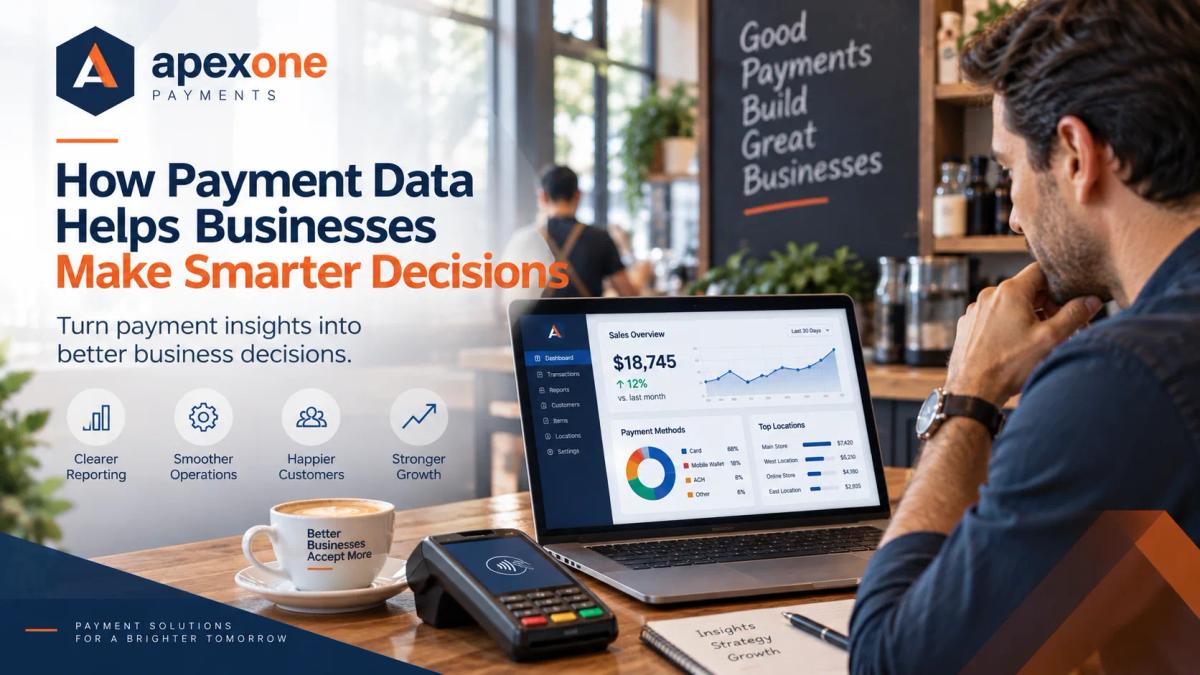
How Payment Data Helps Businesses Improve Operations and Make Smarter Decisions
Every payment creates useful business information. With the right payment and reporting infrastructure, businesses can turn transaction data into clearer operational decisions, better customer experiences, and stronger day-to-day performance.
A payment is more than the moment a customer taps a card, inserts a chip, or completes a digital transaction.
For a business, that transaction becomes part of a much larger picture. It can contribute to sales reporting, payment trends, operational visibility, customer insights, location performance, and decisions about how the business should operate.
The challenge is that many businesses collect this information without really using it.
Transactions are processed. Deposits arrive. Receipts are generated. Reports are downloaded. But when payment information is spread across disconnected systems, the business can still struggle to answer simple questions about what is actually happening.
Which payment channels are being used most? Which locations are performing differently? When are customers buying? Which services or products are generating stronger results? Are payment problems creating unnecessary work for staff? Are refunds, deposits, and transaction activity easy to understand?
These are business questions, not simply payment questions.
That is why payment data has become increasingly important to modern businesses. The value is not in collecting more information for the sake of having more information. The value is being able to turn relevant transaction information into decisions that improve the way the business operates.
Apex One Payments approaches payment technology with this broader view. Its reporting and analytics offering is built around in-person and online payments, while its broader platform connects payment processing, POS technology, devices, and business operations.
For businesses looking beyond a basic card terminal, that difference matters.
Payment Data Has Become Part of the Business Operation
For years, payment processing was treated as a back-office function.
The priority was simple: accept the customer's card, receive approval, and move on to the next transaction.
That still matters, but modern businesses have much more to manage.
A customer might purchase in a physical location, pay online, use a payment link, receive an invoice, or complete a transaction through a mobile device. Retailers may operate stores alongside ecommerce. Restaurants may combine dine-in, online ordering, delivery, and pickup. Service businesses may collect deposits, invoices, and payments at customer locations.
The payment environment has become part of the overall customer and operational journey.
Apex's omnichannel payment offering addresses businesses that accept payments through different channels and emphasizes the importance of bringing those payment activities into a more organized workflow.
That creates an opportunity for businesses to look at payment information differently.
Instead of asking only whether transactions are being processed, business owners can ask whether their payment system is giving them enough visibility to understand their business.
That is where useful payment data starts becoming a business asset.
Better Visibility Changes the Quality of Business Decisions
Business owners make decisions every day.
They decide when to schedule employees, what products to promote, which locations need attention, where operational problems are occurring, and which parts of the customer experience need improvement.
Those decisions become easier when the underlying information is clear.
Payment reporting can provide a useful view into transaction activity, payment trends, deposits, refunds, and other payment-related activity. The exact information available depends on the payment platform and the way the business is configured.
Apex's reporting and analytics offering is positioned around helping businesses manage payments and run their operations from one platform.
This is important because reporting should not exist simply to produce another spreadsheet.
Good reporting should help answer business questions.
If sales are changing, the owner should be able to investigate. If one location is performing differently from another, management should be able to see it. If payment activity creates confusion around deposits or refunds, the reporting should help clarify what happened.
That is the practical value of payment data.
Payment Data Can Reveal Where Operations Need Attention
Not every business problem starts with an obvious complaint.
Sometimes the warning sign is hidden in transaction activity.
A business might notice that certain periods consistently generate more sales. Another location may have a different transaction pattern. A particular service may produce stronger revenue than others. A payment channel may be used more frequently than expected.
These patterns can help management decide where to look more closely.
The important point is not to assume that a transaction pattern automatically explains why something is happening. Data shows activity; business context is still required to understand the reason behind it.
That distinction matters.
Payment data should support decisions, not replace judgment.
For example, if one location is generating stronger sales, management can investigate staffing, inventory, customer demand, promotions, operating hours, or other factors. If a payment channel is being used more frequently, the business can consider whether that reflects customer preference or simply the way transactions are currently being presented.
The payment data provides the starting point.
The business decision comes from combining that information with operational knowledge.
Customer Experience Is Closely Connected to Payment Experience
Customers may never see a merchant dashboard, payment report, or transaction record.
They do experience the payment process itself.
A slow terminal, failed transaction, confusing checkout process, or unclear payment workflow can affect how customers perceive a business.
Apex's content on payment friction addresses this from the operational side as well. Payment problems do not only affect customers; employees can spend time retrying cards, checking invoice status, updating records, or resolving payment questions.
Payment data can help businesses understand where these problems are occurring.
If a business regularly experiences failed transactions, refunds, payment disputes, or other unusual activity, those patterns deserve attention.
The goal is not to treat every failed payment as a major problem. Some failures are normal parts of payment processing.
The value comes from identifying repeated patterns that may point toward an operational issue.
A business that can see those patterns has a better opportunity to address them.
Payment Reporting Should Connect With the Way the Business Operates
A reporting dashboard is only useful if the information inside it makes sense to the people using it.
A retailer may care about sales, products, locations, inventory, and customer activity.
A restaurant may care about sales by location, service periods, orders, payment methods, and staff activity.
A service business may care about invoices, deposits, job payments, recurring billing, and mobile transactions.
A healthcare organization may have its own payment and reporting requirements.
That is why payment technology should be considered in the context of the business rather than as a standalone terminal.
Apex's retail platform, for example, connects checkout, inventory, ecommerce, payments, and reporting across stores and sales channels. It also provides location and inventory visibility as part of its retail POS environment.
For service businesses, Apex also provides payment solutions designed around appointments, deposits, card-on-file payments, checkout, and reporting. Its personal-services solution specifically highlights reporting around services, staff, and time slots.
The underlying principle is simple: payment information becomes more useful when it connects with the operation it represents.
Payment Data Can Help Businesses Understand Customer Behavior
Customer payment activity can provide useful signals about purchasing behavior.
Businesses may be able to understand transaction frequency, average transaction values, payment preferences, or differences between new and returning customers, depending on the systems they use and the data available to them.
Square, for example, currently positions its analytics around sales, customers, locations, employees, and items, while its customer insights can show measures such as visits, spending, and average spend per customer.
This illustrates where the payment industry is heading.
Payment technology is becoming increasingly connected with broader business intelligence.
For a business, the practical question is what to do with that information.
If customers repeatedly purchase certain products together, that may inform merchandising. If returning customers have materially different spending patterns, that may influence customer retention efforts. If particular services perform better during certain periods, that may affect staffing or scheduling decisions.
But responsible businesses should also be careful about how customer information is collected, interpreted, stored, and used.
Payment data should be handled securely and only used in ways appropriate to the business relationship and applicable requirements. The goal is better business understanding, not unnecessary collection or misuse of customer information.
Multi-Location Businesses Need Payment Visibility Even More
Payment data becomes particularly valuable when a business operates multiple locations.
A single location may be manageable through direct oversight. Once a business has several locations, owners and management teams need better visibility into what is happening without being physically present everywhere.
Location-level reporting can help management compare performance while preserving the details of individual locations.
Square, for example, provides reporting across locations, employees, items, and payment activity, while its enterprise offering emphasizes centralized reporting and location-level controls.
Apex's own retail environment similarly connects payment, inventory, ecommerce, and reporting across stores and sales channels.
For a growing company, this type of visibility can make a meaningful difference.
Management can identify differences between locations, investigate unusual patterns, and understand performance without treating every location as a completely separate business.
That becomes even more important as the number of locations increases.
Better Reporting Can Reduce Administrative Work
The value of payment data is not limited to strategic decisions.
It can also affect the amount of administrative work employees perform every day.
When payment information is disconnected, staff may spend time comparing reports, checking deposits, looking for transactions, confirming refunds, or trying to determine whether a payment was connected to the correct order or invoice.
Apex has addressed this problem in its content about sales, settlements, and bank deposits. Clear reporting can make it easier to understand sales, deposits, refunds, chargebacks, adjustments, and fees rather than leaving business owners to guess why numbers do not appear to match.
Its settlement-focused content makes the same broader point: fast funding is useful, but businesses also need to understand what happened to the money after a transaction was processed.
This is where reporting becomes an operational tool.
The better the business can understand payment activity, the less time employees may need to spend searching for answers that should already be available.
Payment Data Can Support Better Planning
Good business decisions are rarely based on one transaction.
They are based on patterns.
Payment reporting can help businesses look at those patterns over time, depending on the capabilities of the system.
Management may compare periods, locations, payment methods, products, services, or other available categories to understand how the business is changing.
Square's current reporting capabilities, for example, include sales trends, payment methods, transaction history, item sales, location filters, and other reporting dimensions.
Apex's approach is similarly centered on providing businesses with clearer payment visibility through reporting and analytics.
The purpose is not to stare at charts all day.
It is to make important business decisions with better information.
If the business is considering a new location, changing operating hours, adjusting inventory, reviewing payment methods, or improving checkout, historical transaction information can become one useful input into that decision.
The Most Valuable Payment Data Is the Data You Can Actually Use
More data does not automatically mean better decisions.
A business can have dozens of reports and still struggle to understand what matters.
The useful question is whether the information is accessible, understandable, and connected to a real business decision.
A restaurant owner may not need every available metric. They may need to know which locations are performing differently, when demand is highest, and whether payment or checkout issues are affecting service.
A retailer may care about product performance, payment activity, customer behavior, and inventory movement.
A service business may care more about deposits, invoices, staff activity, recurring payments, and customer payment history.
The right reporting environment should help each business focus on the information that actually matters.
This is one reason choosing a payment provider should involve more than comparing processing rates.
The technology behind the payment relationship matters too.
Payment Technology Is Becoming Part of the Customer Relationship
A payment transaction can tell a business that a purchase happened.
Connected payment technology can provide much more context around that transaction.
Depending on the platform, a business may be able to connect payments with customers, products, services, locations, employees, orders, invoices, or other operational information.
That creates opportunities to make the customer experience more consistent.
For example, a business that understands returning customer activity can create more relevant experiences. A service company can make it easier to recognize previous transactions. A retailer can connect payment activity with inventory and order management. A multi-location business can provide a more consistent experience across stores.
Apex's retail platform is designed around this type of connected operation, combining checkout, inventory, ecommerce, payments, and reporting.
The payment itself remains important, but the surrounding information can become equally valuable.
Businesses Should Not Have to Piece Together Their Payment Story
One of the biggest weaknesses in a disconnected payment environment is that no single system tells the complete story.
Sales may be in one place.
Payments may be somewhere else.
Invoices may be tracked separately.
Deposits appear in the bank.
Customer information lives in another platform.
The business owner then has to connect everything manually.
That approach may work for a while, but it becomes harder as transaction volume, staff, locations, and sales channels increase.
Connected payment technology can reduce some of that fragmentation by bringing more of the payment workflow into a unified environment.
Apex positions its reporting and analytics product around this broader idea of accepting payments, managing devices, and running the business from one platform.
For a growing business, that can be much more valuable than simply having another card terminal.
Why Payment Data Matters When Choosing a Payment Provider
When businesses evaluate payment providers, the conversation often starts with rates.
Rates matter.
But they are not the entire payment relationship.
A business should also consider what happens after a transaction is approved.
Can the business understand its payment activity? Can management access useful reporting? Can the system support multiple locations? Can it connect with the business's POS? Can employees manage transactions without unnecessary work? Can the payment environment support online and in-person operations where needed?
These questions become increasingly important as a business grows.
A provider that only focuses on processing transactions may solve one part of the problem.
A provider that understands payment processing, POS technology, reporting, hardware, and the business workflow can help address a much broader set of needs.
That is the space Apex One Payments is designed to serve.
How Apex One Payments Turns Payment Technology Into a Business Tool
Apex One Payments provides more than payment acceptance.
Its platform brings together payment processing, POS systems, payment terminals, merchant services, and reporting solutions for businesses across industries.
The company's reporting and analytics solution is specifically positioned around reliable in-person and online payments, while the broader platform allows businesses to accept payments, manage devices, and run their operations from one environment.
For retailers, Apex connects checkout, inventory, ecommerce, payments, and reporting across stores and sales channels.
For restaurants, Apex provides POS and payment solutions that connect ordering, payment processing, tableside service, online ordering, and reporting. This gives restaurant operators a more connected view of their payment and operational activity.
For service businesses, Apex supports workflows that can include scheduling, deposits, card-on-file payments, checkout, and reporting, helping businesses manage payments around the way their customers actually receive services.
Businesses can explore Apex reporting and analytics to see how payment visibility fits into a broader business payment environment.
Those looking for complete payment technology can also explore POS systems and payment hardware, while businesses in specific industries can review Apex's retail payment solutions, restaurant POS and payment solutions, healthcare payment processing, and payment processing for service businesses.
The important part is not adding technology for the sake of having more technology.
It is creating a payment environment that gives the business better control over what happens before, during, and after every transaction.
The Difference Is in What a Business Does With Its Payment Information
Every business processes payments.
The difference is what happens next.
Some businesses simply wait for the deposit to appear in the bank.
Others use payment information to understand performance, identify operational problems, improve customer experiences, and make better decisions.
That does not require turning a business into a data science project.
It requires having payment systems that provide useful information and making that information part of normal business management.
For growing businesses, this becomes increasingly important.
More customers create more transactions. More locations create more reporting requirements. More sales channels create more payment activity. More employees create more operational complexity.
A connected payment environment can give management a clearer view of what is happening without requiring employees to manually piece together information from multiple systems.
Better Decisions Start With Better Visibility
Payment data will not tell a business everything it needs to know.
It will not replace customer conversations, employee experience, financial planning, or management judgment.
But it can provide an important view into what is happening across the payment side of the business.
That visibility can help businesses recognize patterns, investigate problems, understand customer activity, compare locations, and make operational decisions with more context.
The strongest payment systems are therefore not simply transaction machines.
They are part of the infrastructure that helps a business operate.
For Apex One Payments, that is the opportunity: helping businesses move from simply accepting payments to managing payment activity with greater clarity.
Make Your Payment System Work Harder for Your Business
Your payment system should not disappear into the background after a transaction is approved.
It should help your business understand what is happening.
Whether you operate a retail store, restaurant, healthcare practice, service business, or multiple locations, the right combination of payment processing, POS technology, reporting, and hardware can give you a clearer picture of your operations.
Apex One Payments provides payment processing and business payment technology designed around the way modern businesses operate.
If your current payment system gives you limited reporting, disconnected information, or little visibility into what happens after a transaction, it may be time to look at what a more connected setup could do for your business.
Explore Apex One Payments reporting and analytics, review POS and payment hardware, or contact Apex One Payments to discuss a payment environment built around your business.
The goal is not simply to process more payments.
It is to make every part of the payment experience more useful to the business behind it.
Frequently Asked Questions
How can payment data help a business make better decisions?
Payment data can give businesses greater visibility into transaction activity, payment methods, sales patterns, locations, refunds, and other available information. When that information is clear and relevant, management can use it alongside other business information to make more informed operational decisions.
What types of payment data can businesses use?
Depending on the payment system, businesses may have access to information such as transaction activity, payment methods, sales trends, deposits, refunds, disputes, locations, products, services, or customer activity. The specific information available depends on the provider, system configuration, and business needs.
Can payment data improve customer experience?
Payment data can help businesses identify patterns that may affect customer experience, including payment failures, checkout issues, transaction preferences, and customer purchasing behavior. Businesses can then use those insights alongside operational information to improve the payment journey.
Why is payment reporting important for businesses?
Payment reporting helps businesses understand what happened after transactions were processed. Clear reporting can make it easier to review sales, deposits, refunds, fees, disputes, and other payment activity while reducing the need to piece information together manually.
Can payment data help multi-location businesses?
Yes. Businesses with multiple locations can use location-level payment and sales information to understand how different locations are performing. Connected reporting can give management a broader view while still allowing individual locations to be reviewed separately.
Does Apex One Payments provide reporting and analytics?
Yes. Apex One Payments provides a Reporting & Analytics solution designed around in-person and online payments. The company also provides POS, payment processing, payment terminals, and industry-specific payment solutions.
Can Apex One Payments support retail businesses with payment reporting?
Yes. Apex's retail payment environment connects checkout, inventory, ecommerce, payments, and reporting across stores and sales channels, providing retailers with a more connected operational environment.
Can Apex One Payments support restaurants and service businesses?
Yes. Apex provides restaurant payment and POS solutions as well as payment solutions for service businesses. These solutions are designed around the different ways restaurants and service providers interact with customers and collect payments.
How can I find out whether my current payment system provides enough visibility?
Start by looking at how easily your business can understand transactions, deposits, refunds, payment methods, customer activity, and location performance. If employees regularly have to compare multiple systems or manually piece together payment information, it may be worth reviewing your current payment and reporting setup.
How can I speak with Apex One Payments about my business payment needs?
You can contact Apex One Payments to discuss your payment processing, POS, reporting, hardware, and business requirements and determine what type of payment environment fits your operation.